In this section you will find shorts inspired by passages, moments and scenes from the book
Autobiography of a Yogi. All the videos have been created using highly elaborate and intricate
Artificial Intelligence techniques. For this reason, any donation to help
continue producing this beautiful content will be received with the deepest gratitude. I sincerely hope
you enjoy every one of them and that they help you feel even closer to all our Gurus and Paramgurus. May
God bless you. Om, Shanti, Amen.
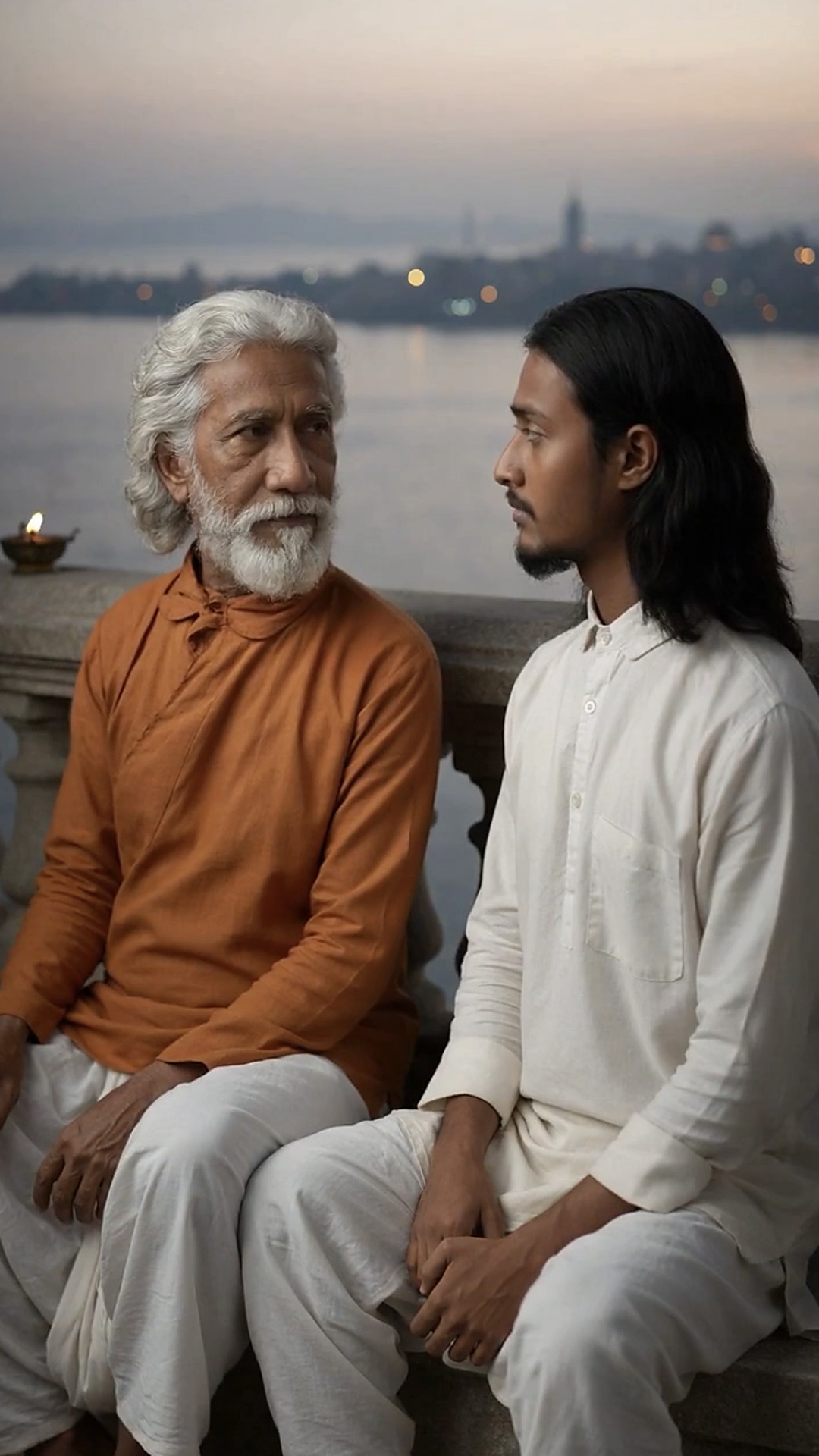
"Will you give me the same unconditional
love?"
In Benares, after their first encounter, Sri Yukteswar asks Mukunda to promise
him an eternal love and confides in him a lifelong request.
"Will you give me the same unconditional love?"
Chapter X · "I meet my master, Sri Yukteswar"
After the first miraculous encounter in the alley of Benares, Sri Yukteswar leads young Mukunda
to his temporary residence, on a stone balcony overlooking the Ganges. There he offers him words
that will mark the relationship between the two for the rest of their lives: he gives him his
unconditional love and asks him, with the innocence of a child, whether the disciple will
reciprocate in the same way. Mukunda promises to love him eternally. The master then adds a
moving request: if he ever sees him fall from the state of divine realization, he should place
his head on the master's knees and help him return to the Cosmic Beloved.
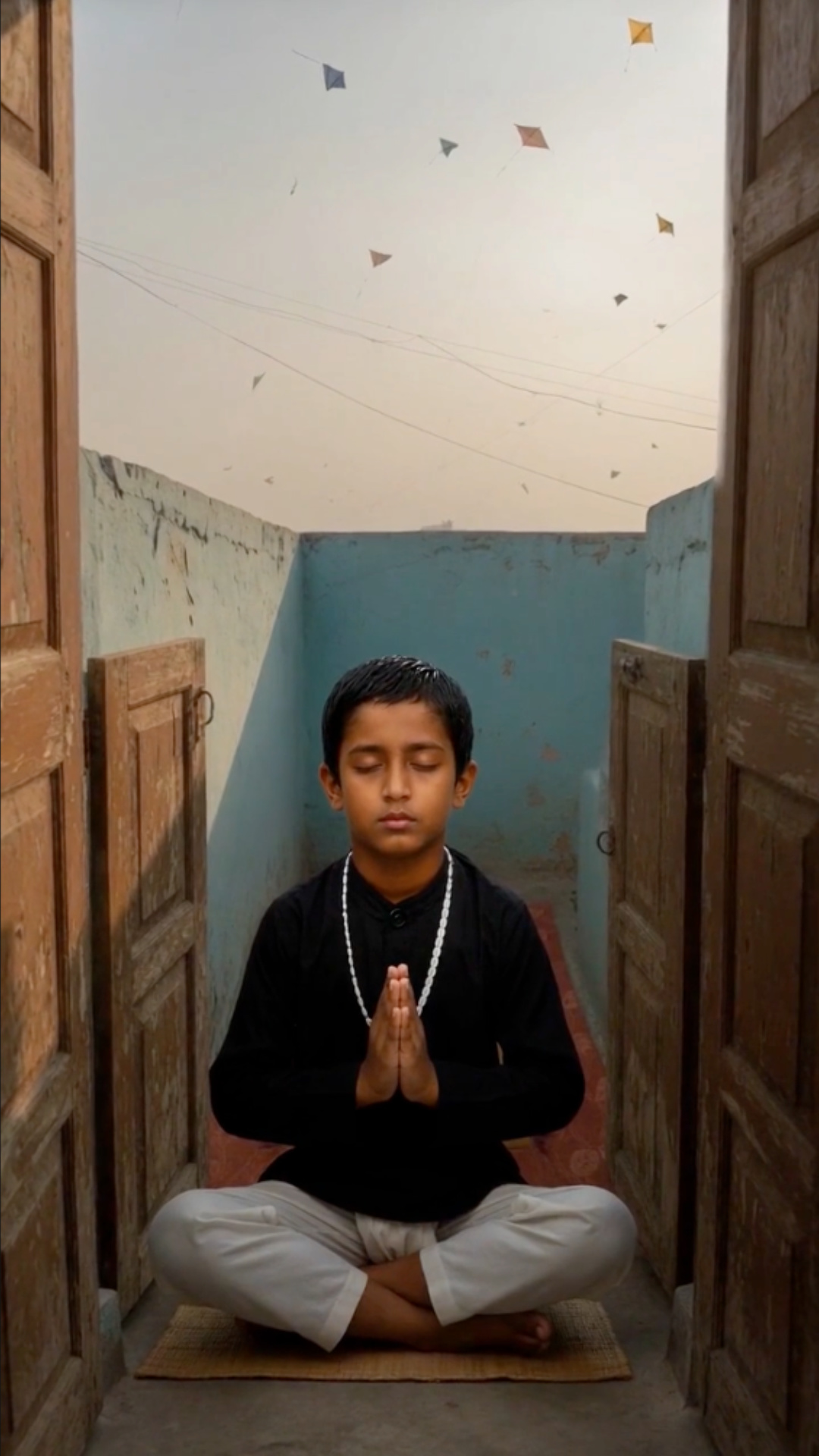
Mukunda meditating in the attic
In a small
attic of the family home at 4 Gurpar Road, young Mukunda gave himself to his sadhana and
prepared his mind for the search for God.
Mukunda meditating in the attic
The attic of the Gurpar Road house · The setting of his Sadhana
In the family home at 4 Gurpar Road, in Calcutta, a small attic became the retreat of young
Mukunda —the future Paramahansa Yogananda—. There, before the photograph of Lahiri Mahasaya, he
gave himself to his meditation practices and prepared his mind for the search for God. That
attic was the setting for so many scenes of his turbulent sadhana: in it he wept until he felt
utterly transformed, "as if he had used a chemical cleanser," when all his family and worldly
attachments dissolved and his resolve to seek God set firm as granite. It was also from its
window that, one rainy morning, he threw the bundle with his blanket, his sandals, the Bhagavad
Gita, a rosary and the portrait of his guru, before his interrupted flight toward the Himalayas.
And it would be in that same corner that, years later, one of his greatest experiences of cosmic
consciousness would come upon him.
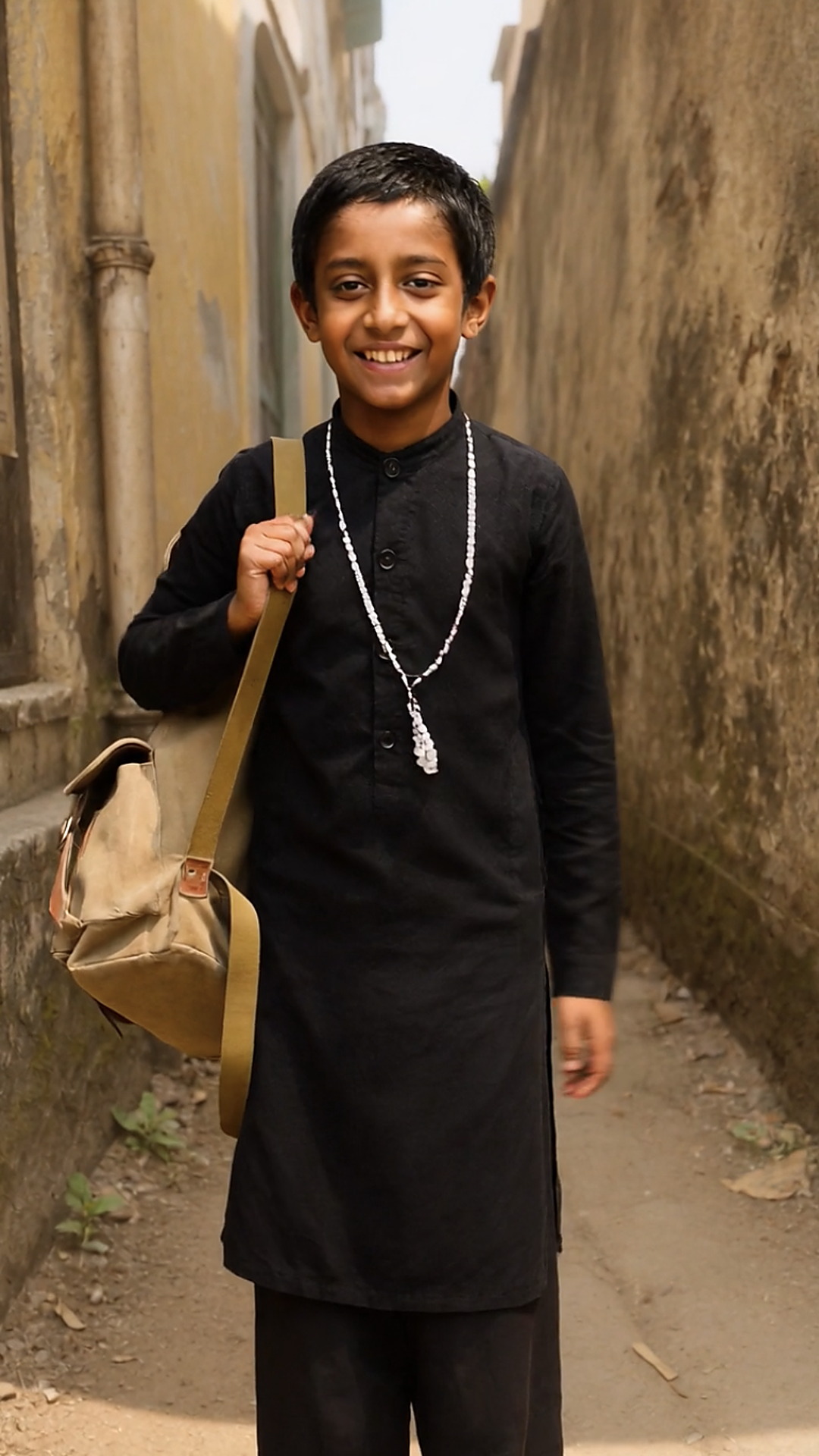
Interrupted flight toward the
Himalayas
Young Mukunda tries to escape to the Himalayas with his friend Amar Mitter
and throws his luggage out the third-floor window.
Interrupted flight toward the Himalayas
Chapter IV · "Interrupted flight toward the Himalayas"
Determined to escape to the Himalayas in search of his master, young Mukunda wraps in a blanket
a few essential belongings: a photograph of Lahiri Mahasaya, a copy of the Bhagavad Gita, a
rosary, sandals and loincloths. He throws the bundle out the window of the third-floor attic of
the family home in Calcutta and runs down the staircase. He stumbles into his uncle at the door
and manages to discreetly pick up the luggage in the alley. The adventure —which will include
European disguises and train tickets— will finally be frustrated, but it is one of the first
vivid images of his spiritual quest.
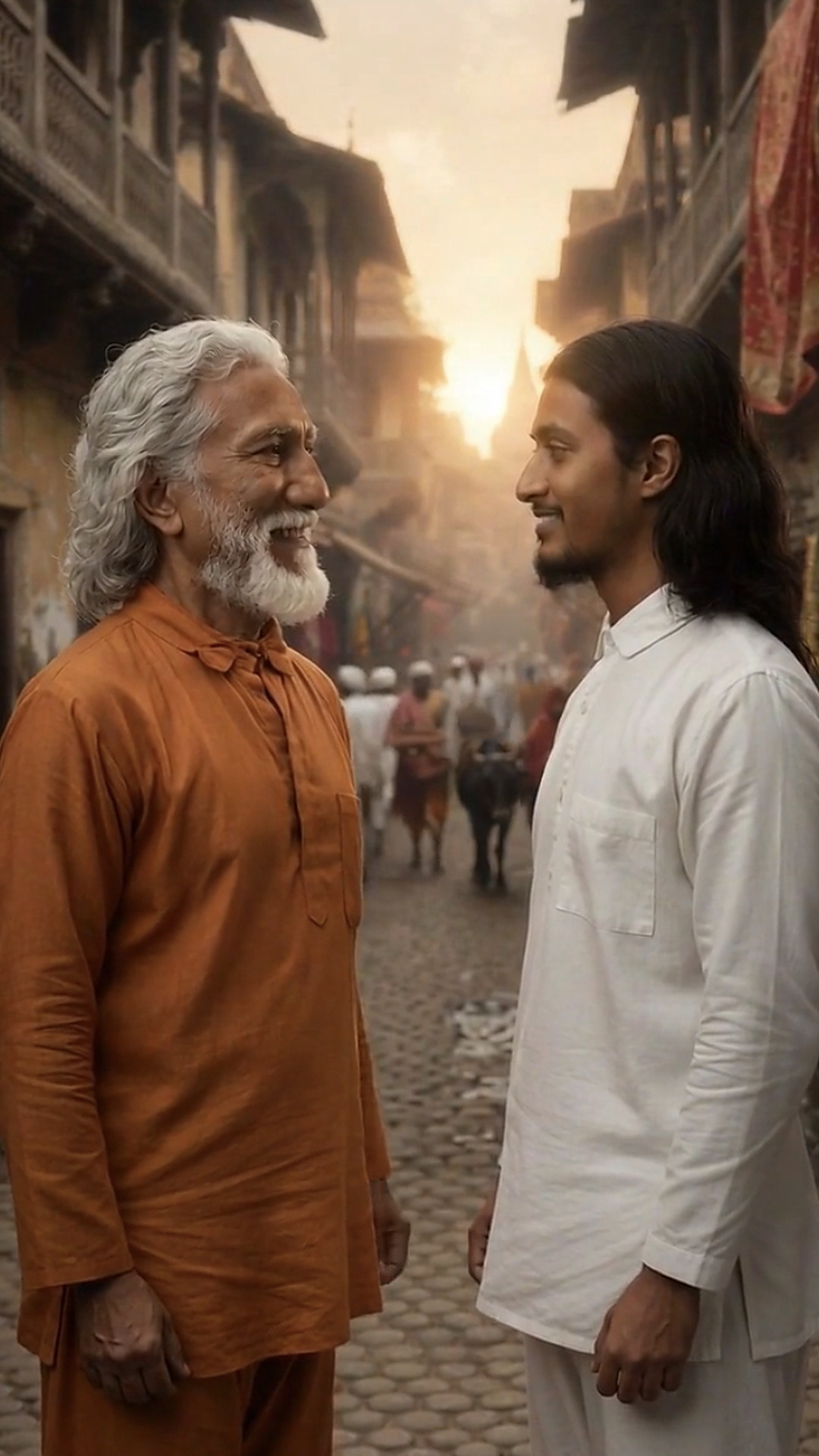
I see my Guru for the first time
In a modest
alley of Benares, Mukunda sees at its end the figure of the master he had seen thousands of
times in his visions.
I see my Guru for the first time
Chapter X · "I meet my master, Sri Yukteswar"
Sent by a young clergyman to a market in the Bengali quarter of Benares, Mukunda crosses the
colorful bustle of the street. Turning his head as he passes a modest alley, he sees at its end,
motionless, a man in the ochre robe of the swamis. The figure feels strangely familiar to him.
After walking a few steps away, he feels his feet grow heavy as stone and cannot continue. He
leaves the packages in the arms of his surprised companion and runs back. Upon reaching the
master's feet, he recognizes in him the face he had seen thousands of times in his visions. It
is Sri Yukteswar, who has been waiting for him for years.
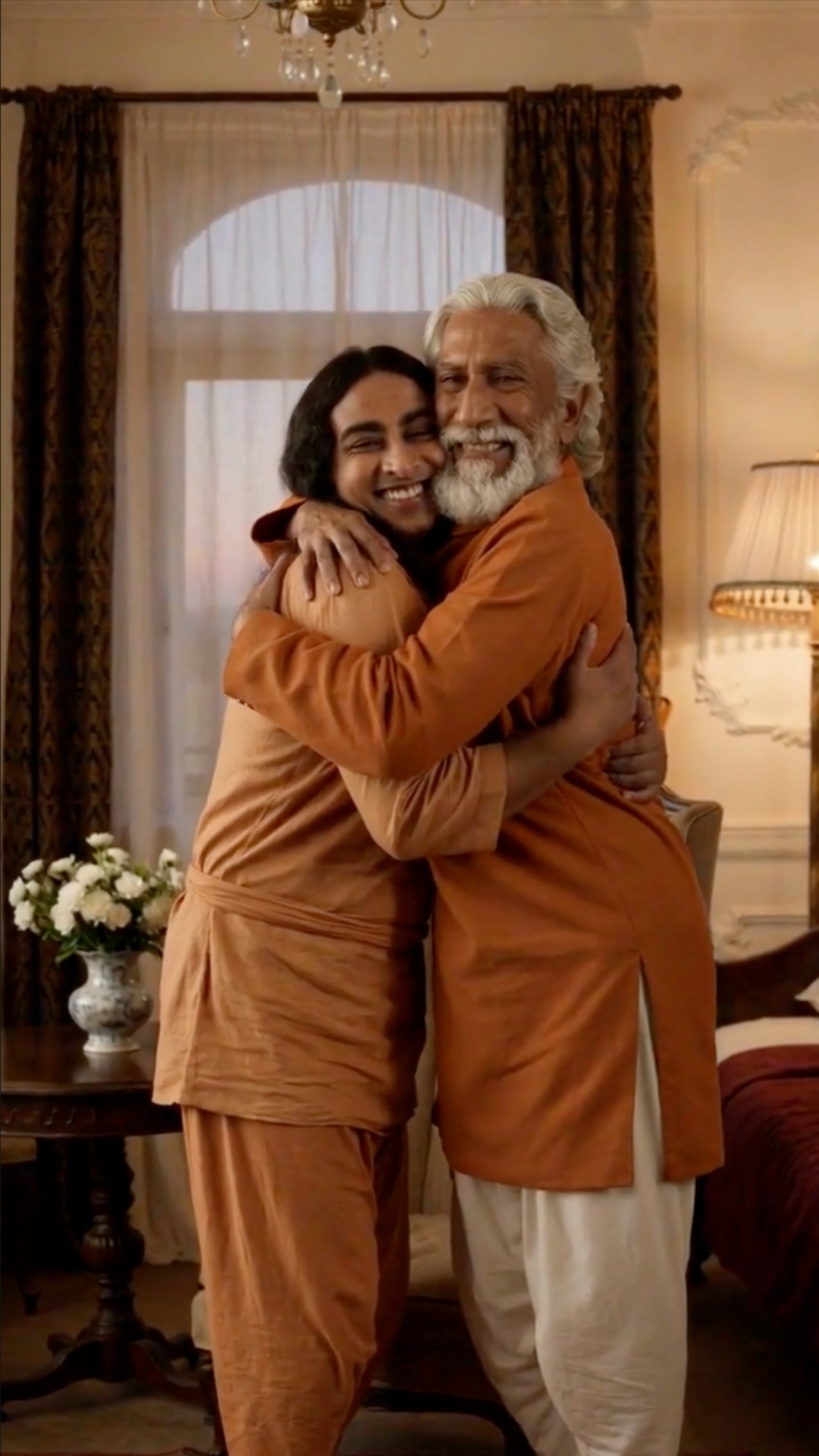
The resurrection at the Regent Hotel
Three
months after his mahasamadhi, Sri Yukteswar appears to Yogananda in Bombay and describes the
astral planet Hiranyaloka.
The resurrection at the Regent Hotel
Chapter XLIII · "The resurrection of Sri Yukteswar"
Three months after the master's passing in Puri, Yogananda is meditating in his room at the
Regent Hotel in Bombay. At three in the afternoon on June 19, 1936, a week after having had a
vision of Krishna, the room fills with a beatific light and Sri Yukteswar appears before him in
flesh and blood. Yogananda breaks the usual protocol: instead of kneeling, he runs to embrace
him. The master explains that he has resurrected on an astral planet called Hiranyaloka with a
body formed from cosmic atoms, and for two hours he reveals to him the secrets of the astral and
causal worlds.
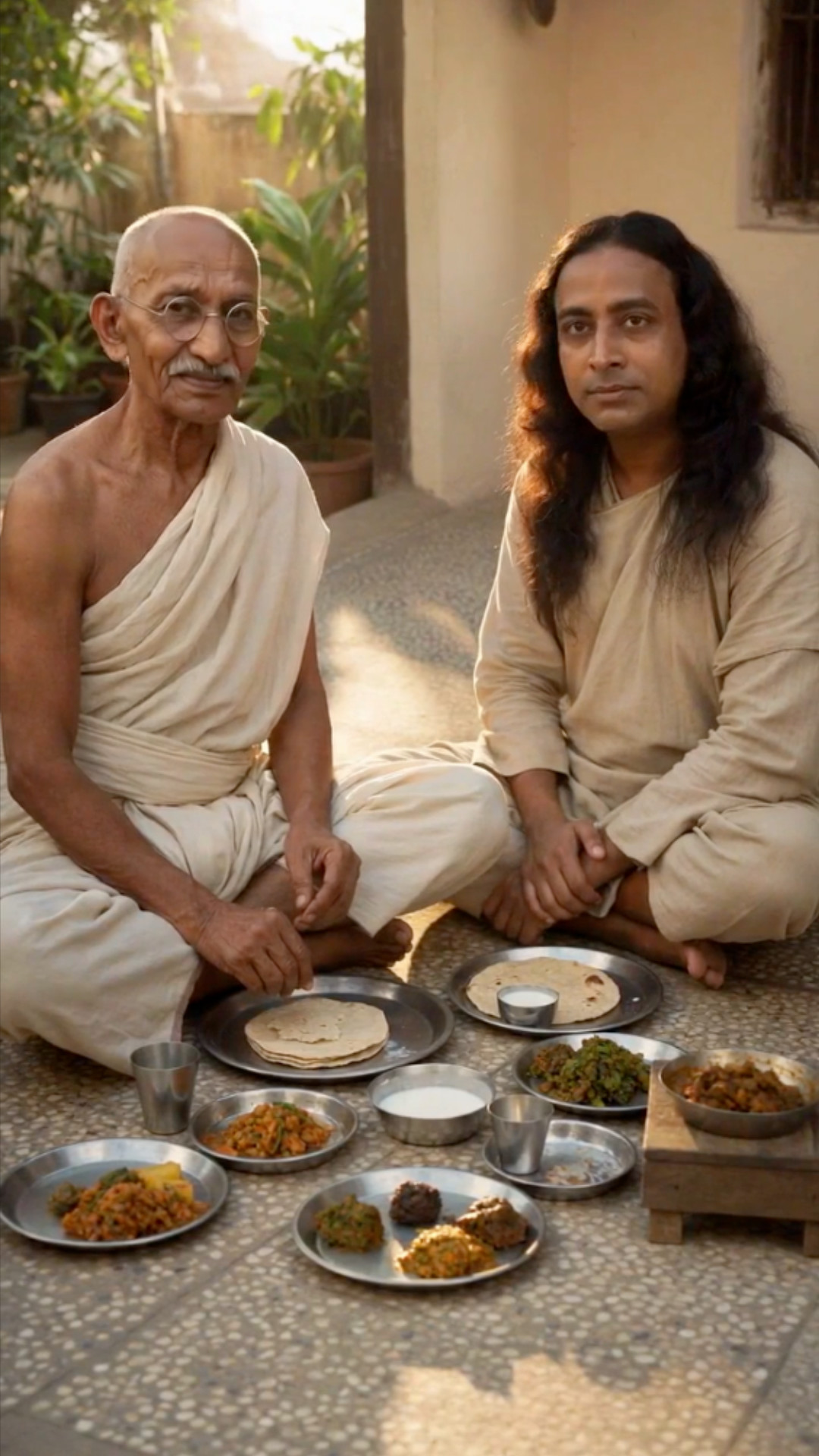
With the Mahatma at the Wardha ashram
In
August 1935, Yogananda visits Gandhi at Wardha. They share simple meals, meditations and long
conversations on religion.
With the Mahatma at the Wardha ashram
Chapter XLIV · "With Mahatma Gandhi at Wardha"
In August 1935, Yogananda visits Mahatma Gandhi's ashram at Wardha. Although it is their first
personal encounter, both look at each other with affection: Gandhi had already visited the
Ranchi school years earlier and had left a tribute in the visitors' book. The small saint,
dressed only in a loincloth as a symbol of unity with the humble masses of India, hands him a
written note of welcome. They share simple meals, meditations on the rooftop at sunset and long
conversations on religion, India and the West. Gandhi asks Yogananda to initiate him in Kriya
Yoga.
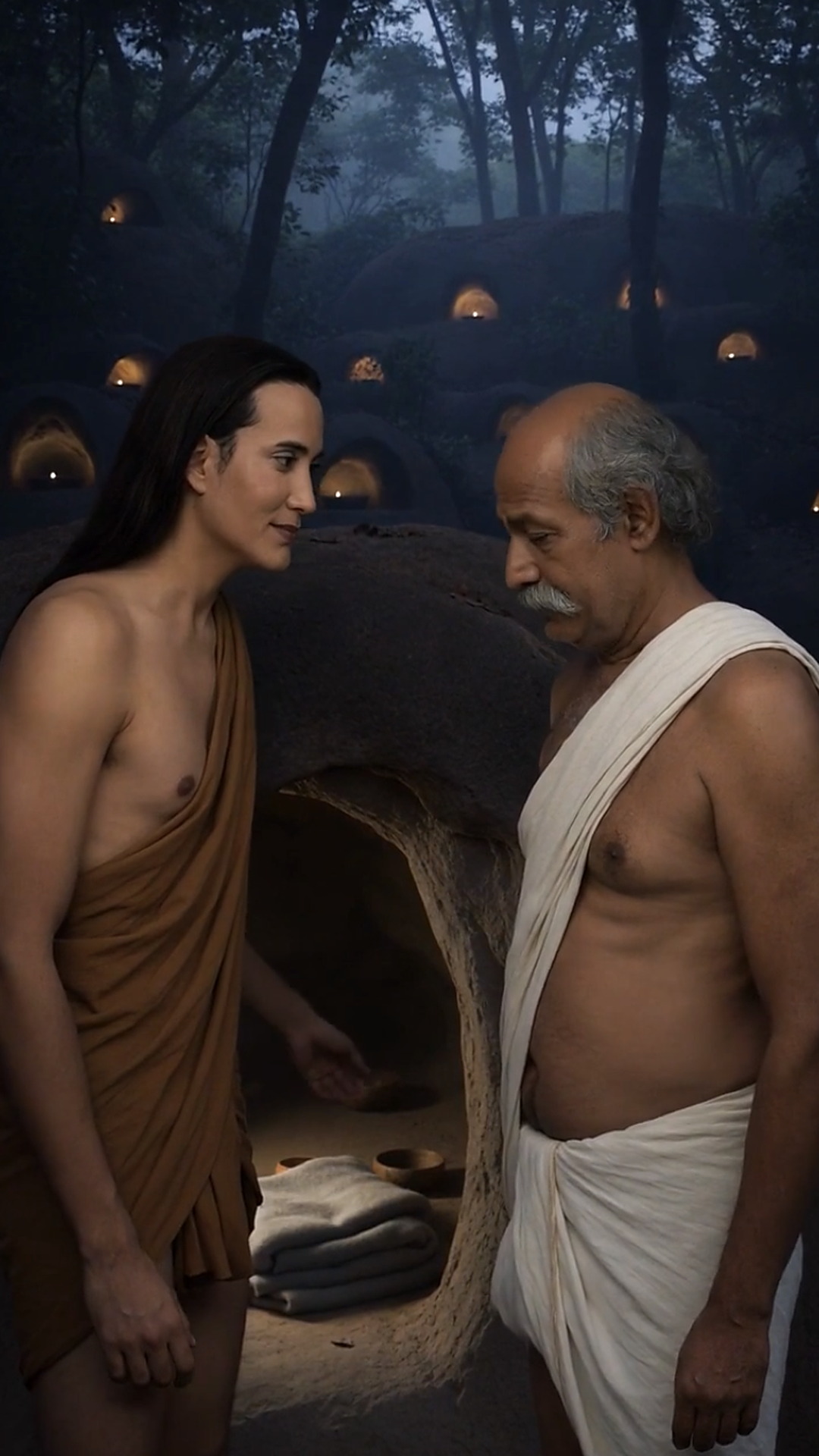
The cave of past lives
Babaji leads Lahiri
to a grotto that had been his home in a previous life; there the re-initiation into Kriya Yoga
begins.
The cave of past lives
Chapter XXXIV · "Materialization of a palace in the Himalayas"
After Babaji's first appearance on Drongiri mountain, the immortal guru leads Lahiri Mahasaya to
a small grotto containing wool blankets and beggar's bowls. He points to a folded blanket in a
corner and asks if he recognizes that seat. Upon gently placing his hand on his forehead, Lahiri
suddenly remembers that in his previous life he had inhabited that same cave for many years.
Babaji confides that he had kept it clean and prepared, awaiting his return for more than three
decades. It is there, next to the Gogash river, where Lahiri's re-initiation into Kriya Yoga and
the reunion between master and disciple begins.
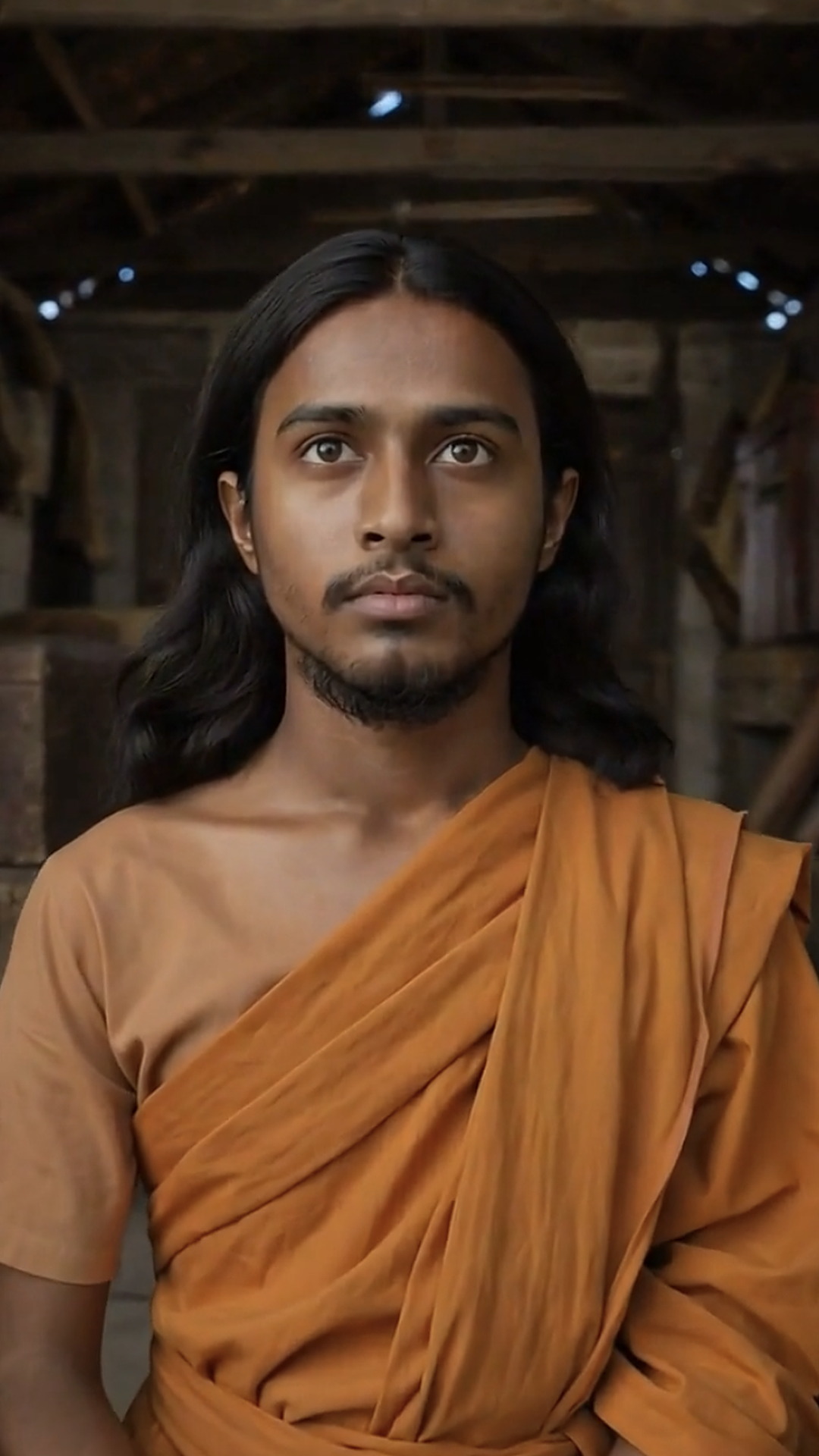
Glimpses of America
At the Ranchi school,
Yogananda meditates and sees a vast multitude of Western faces pass across the stage of his
consciousness.
Glimpses of America
Chapter XXXVII · "I go to America"
Seeking a moment of retreat away from the new students of the Ranchi school, Yogananda sits to
meditate behind some dusty boxes in a basement. During the meditation, a panoramic vision of
places and people of America unfolds before his eyes. Certainty comes to him instantly: the Lord
is calling him to travel. When the basement door opens and a child discovers him, Yogananda
cheerfully announces that he will set out to discover America like a new Christopher Columbus.
Hours later he takes the train to Calcutta.
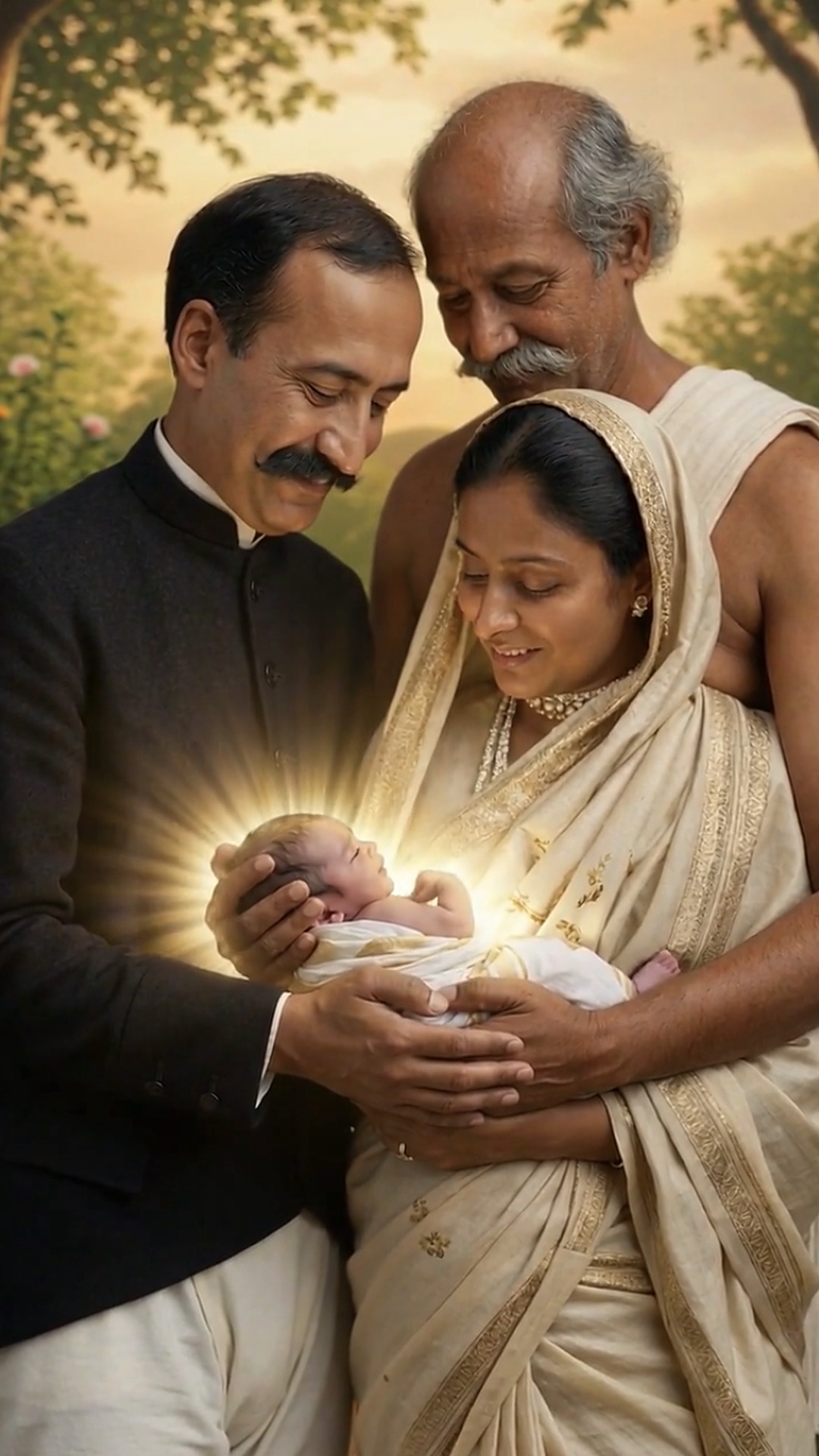
Lahiri Mahasaya blesses Mukunda (Paramahansa
Yogananda)
As an infant, Mukunda is brought before Lahiri Mahasaya, who blesses him
and announces his destiny as a yogi.
Lahiri Mahasaya blesses Mukunda (Paramahansa Yogananda)
Chapter II · "My mother's death and the mystic amulet"
In the posthumous message that Mukunda's mother has delivered to him after her death, she
recalls a decisive episode from the child's earliest years. When he was still an infant in arms,
she took him to Lahiri Mahasaya's house in Benares. Almost hidden among the multitude of
disciples, she silently asked that the master notice them. Lahiri opened his eyes, motioned for
the mother to approach, sat the child on his lap and placed his hand on his forehead as a
spiritual baptism. He then announced that that child would be a yogi and that, like a spiritual
locomotive, he would lead many souls to God's Kingdom.
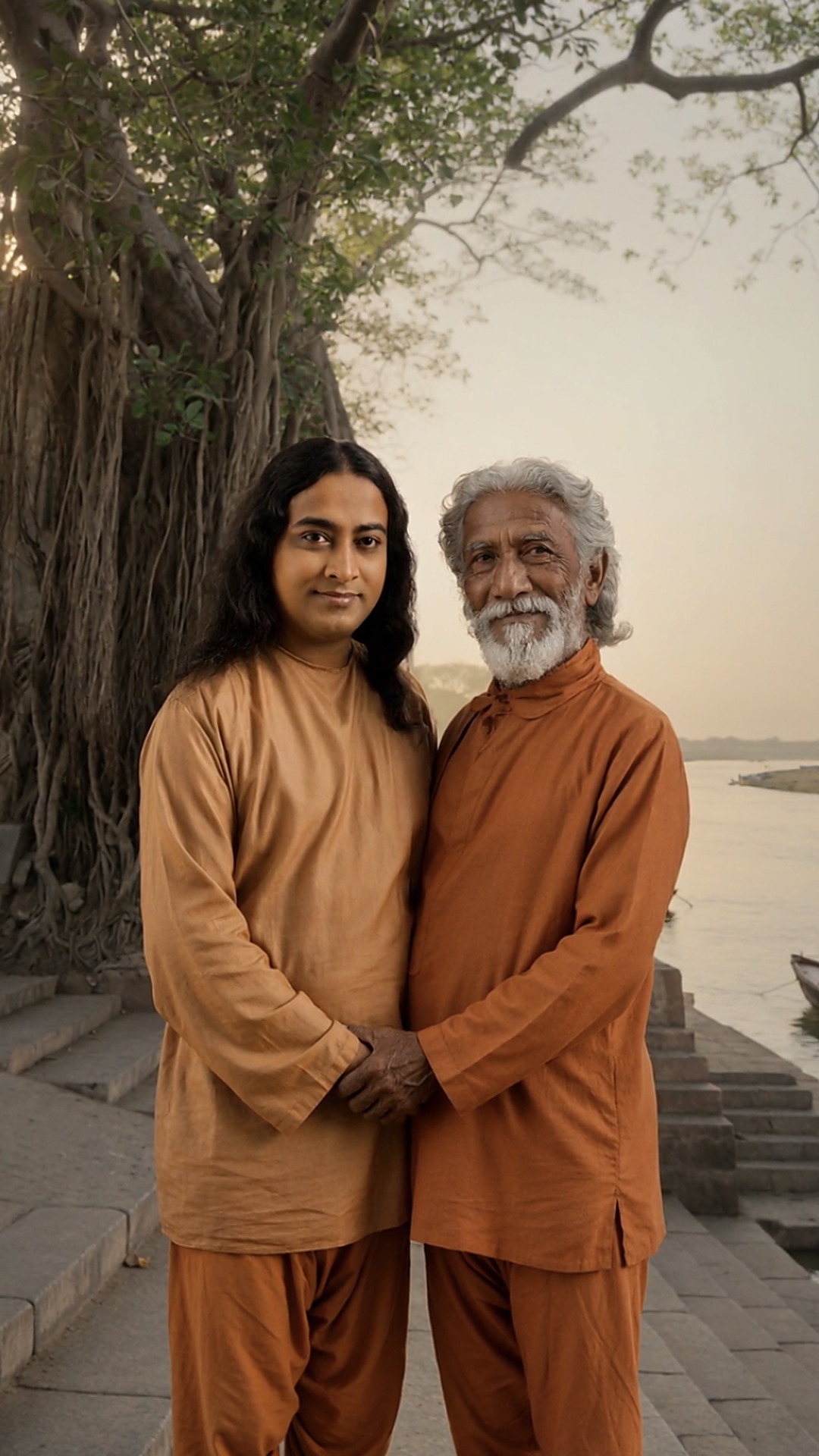
Dawn walks by the Ganges
Master and disciple
walking together at daybreak along the banks of the Ganges after the morning samadhi.
Dawn walks by the Ganges
Chapter XII · "Years in my master's hermitage"
Every morning, after Sri Yukteswar came out of his deep samadhi, master and disciple would
embark together on a long walk along the banks of the Ganges before breakfast. Yogananda
remembers these walks as one of the most vivid images of his life in Serampore: the early sun
warming the river, the master's resonant, rich voice imparting wisdom with the authenticity of
realization. Many of the long philosophical conversations that stretched through the entire
night ended with the master's exclamation upon seeing the dawn: it was time to rise and walk to
the river.
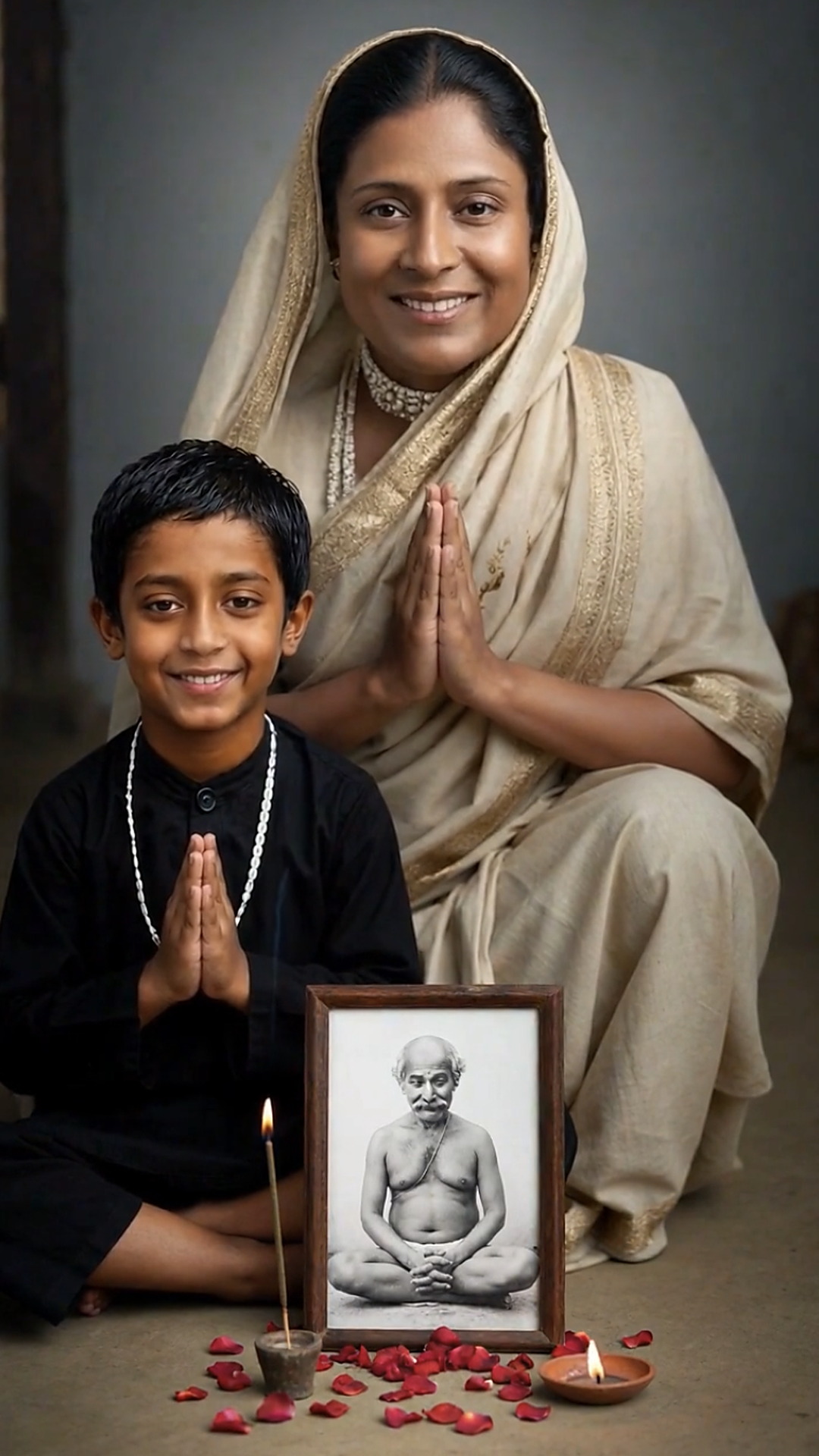
Mukunda (Paramahansa Yogananda) and his mother,
praying to Lahiri
The daily meditations of little Mukunda with his mother before
Lahiri Mahasaya's photograph that presided over the family altar.
Mukunda (Paramahansa Yogananda) and his mother, praying to Lahiri
Chapter I · "My parents and early life"
On the family altar, the photograph of Lahiri Mahasaya —given to the father by the master
himself— presided over the spiritual life of the home in every city where the family lived. Many
mornings and nights found little Mukunda and his mother meditating together before this small
improvised shrine, offering flowers infused with sandalwood paste and incense. The child
recounts how, during these meditations, he frequently saw the guru's image emerge from its frame
and take living form before him. It is also his mother who, when he falls gravely ill with
cholera, makes him look at the portrait: a resplendent light heals him instantly.
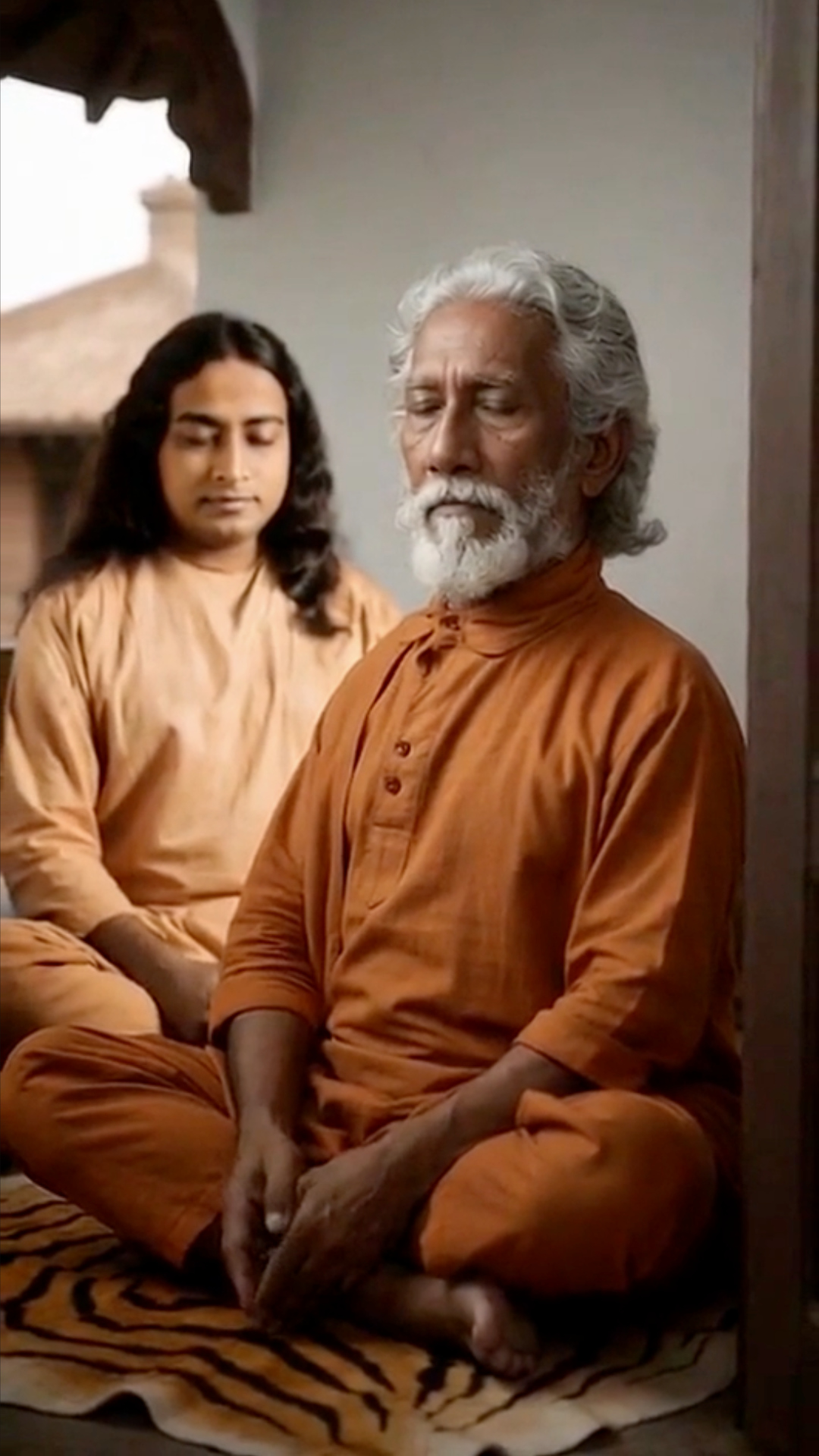
The master on the tiger skin
The first image
of Sri Yukteswar in his Serampore hermitage, seated on the skin that accompanied him throughout
his monastic life.
The master on the tiger skin
Chapter XII · "Years in my master's hermitage"
The first image Yogananda receives of his guru upon arriving at the Serampore hermitage is that
of Sri Yukteswar seated on a tiger skin in the antechamber of the balcony. From that seat —which
was also his usual place for meditation and for conversing with disciples at night— he directed
the life of the hermitage with a serene voice. The tiger skin accompanied the master for
practically all of his monastic life and becomes, throughout the book, the visual symbol of the
guru's seat.
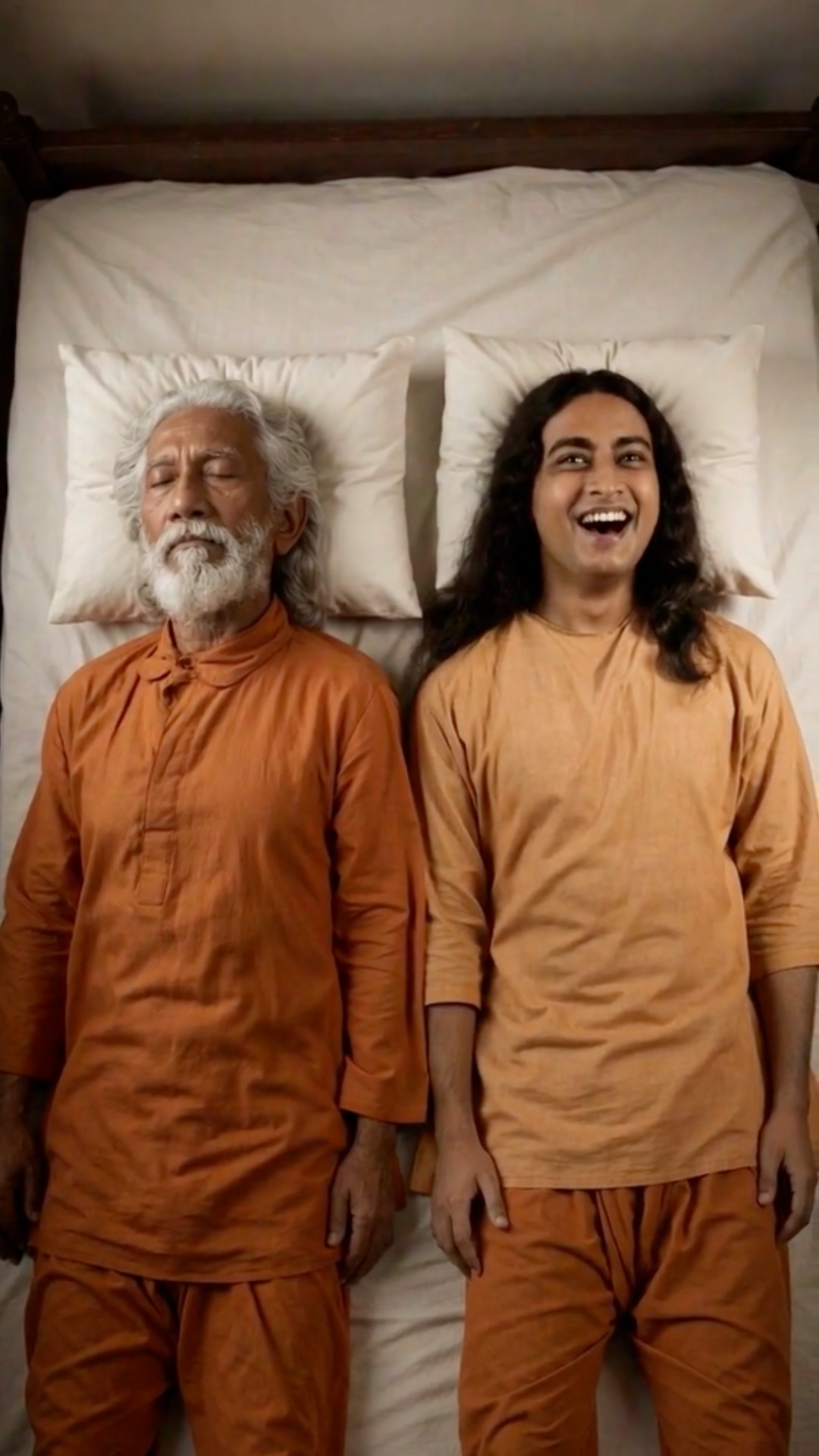
The snores of the master
A tender and
humorous contrast between Yukteswar's deep sleep and his instant awakening into yogic samadhi.
The snores of the master
Chapter XII · "Years in my master's hermitage"
Yogananda recounts that it was easy to know when his master woke up: when his deep snores
suddenly ceased. One or two sighs, a small movement, and then a total silence of breath; then
Sri Yukteswar entered yogic samadhi. The scene is told with humor and tenderness, presenting the
contrast between the apparent relaxation of sleep and the extreme discipline of the yogi's
awakened consciousness. Yogananda slept very close to him, on a narrow cot, as part of his daily
life in the hermitage.
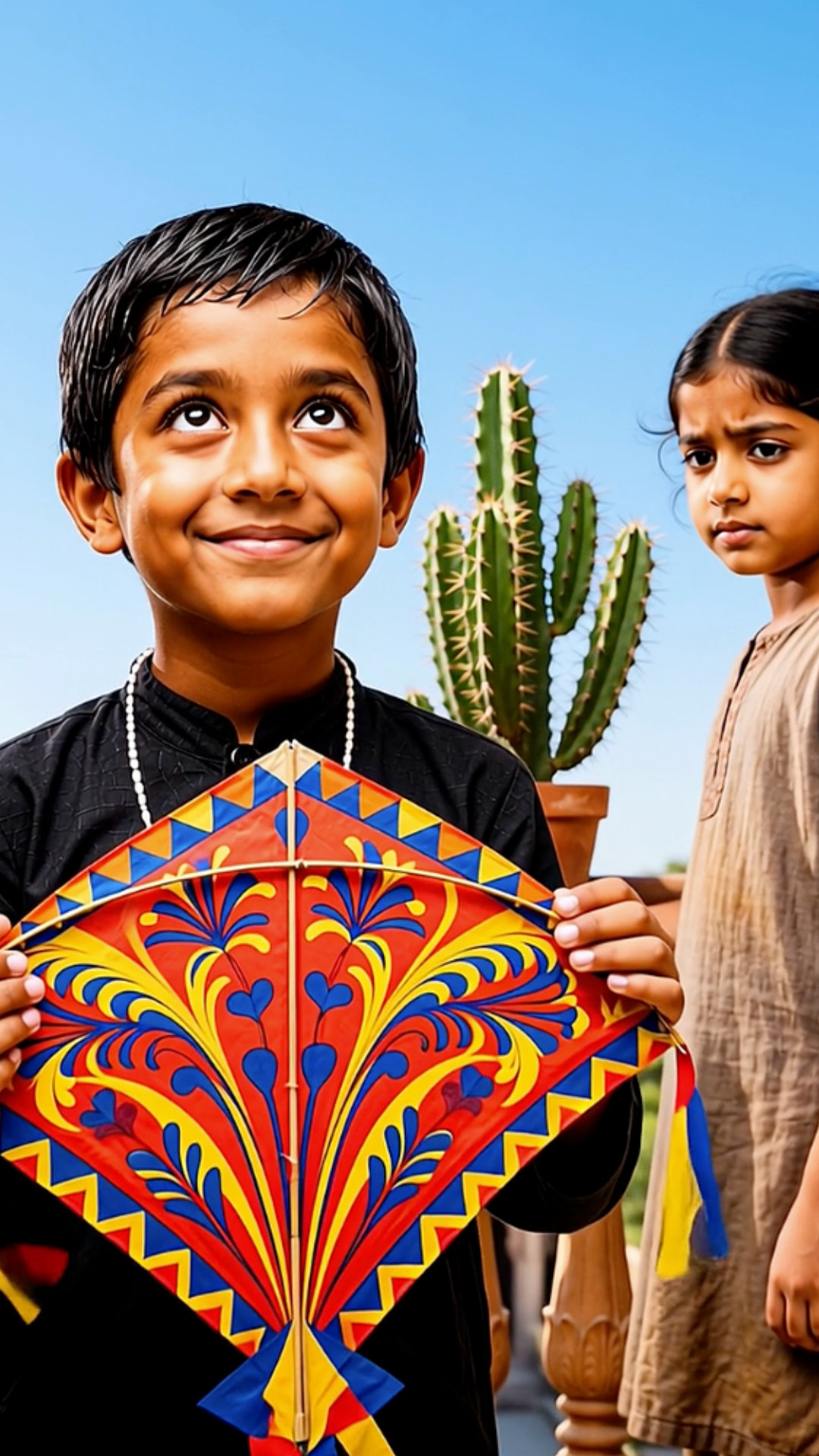
The kite of the Divine Mother
On a balcony
in Lahore, little Mukunda silently asks the Divine Mother for both kites and receives them.
The kite of the Divine Mother
Chapter I · "My parents and early life"
In Lahore, on the balcony of the family home, little Mukunda watches with his sister Uma as two
paper kites battle over the rooftops. Uma teases him when her brother tells her that the Divine
Mother could grant him any wish. Mukunda then silently asks that both kites fall into his hands.
Shortly after, both are cut down, and a cactus on the rooftop opposite miraculously catches the
strings, allowing him to collect them. His sister, frightened, runs off. It is one of the first
experiences of answered faith in the child's life.
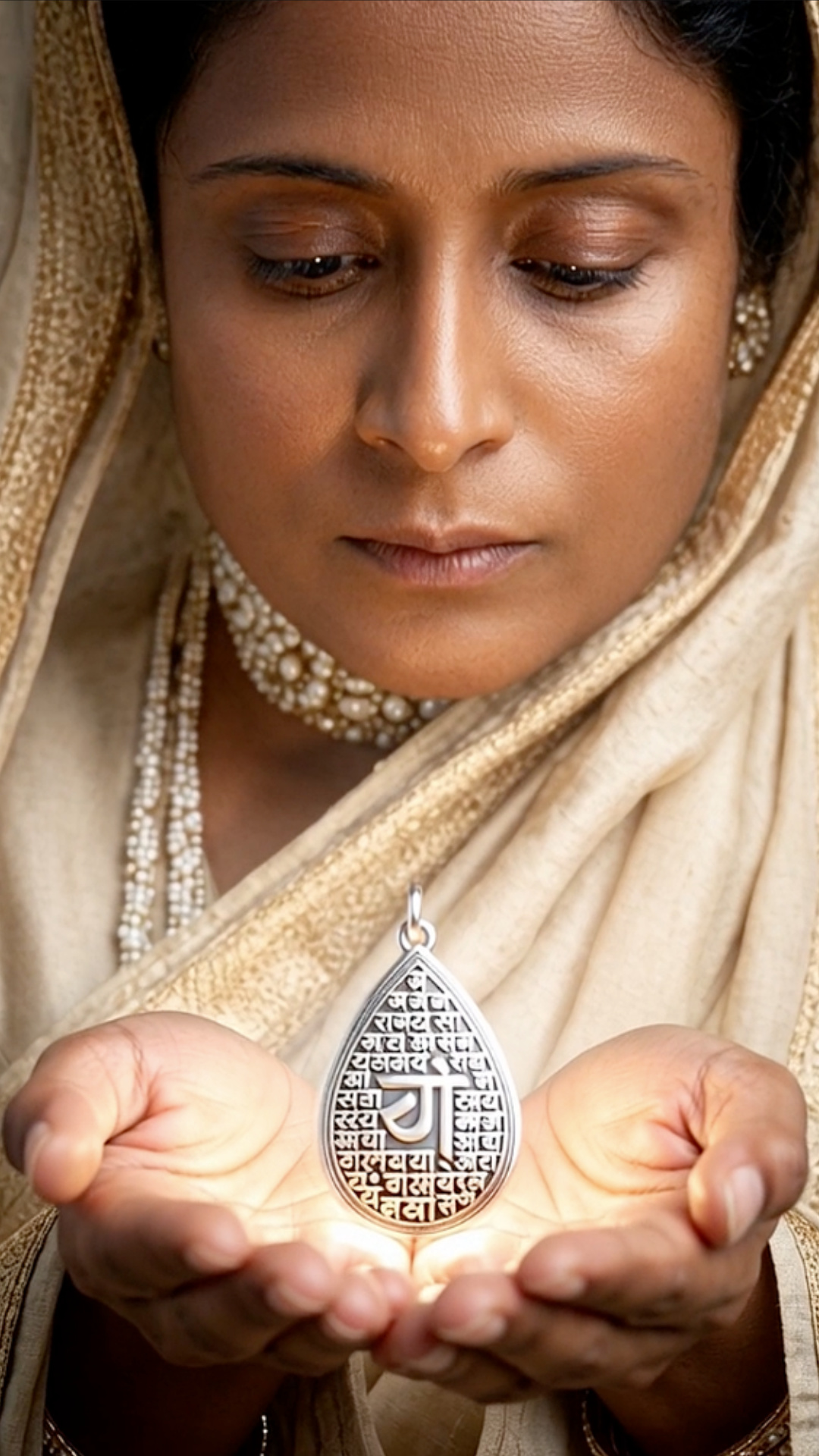
The inherited silver talisman
An unknown
sadhu announces to Mukunda's mother that an amulet will materialize to be delivered to her son.
The inherited silver talisman
Chapter II · "My mother's death and the mystic amulet"
While the family is in Lahore, an unknown sadhu asks to see Mukunda's mother. He announces that
her life on earth will be short and that she must safeguard a silver amulet that will
materialize in her hands during the following night's meditation. He also indicates that, upon
her death, she must pass it to her eldest son and, after one year, deliver it to Mukunda.
Everything happens as foretold. The talisman, covered with Sanskrit characters, comes into young
Yogananda's hands after his mother's death and awakens in him memories of past lives.
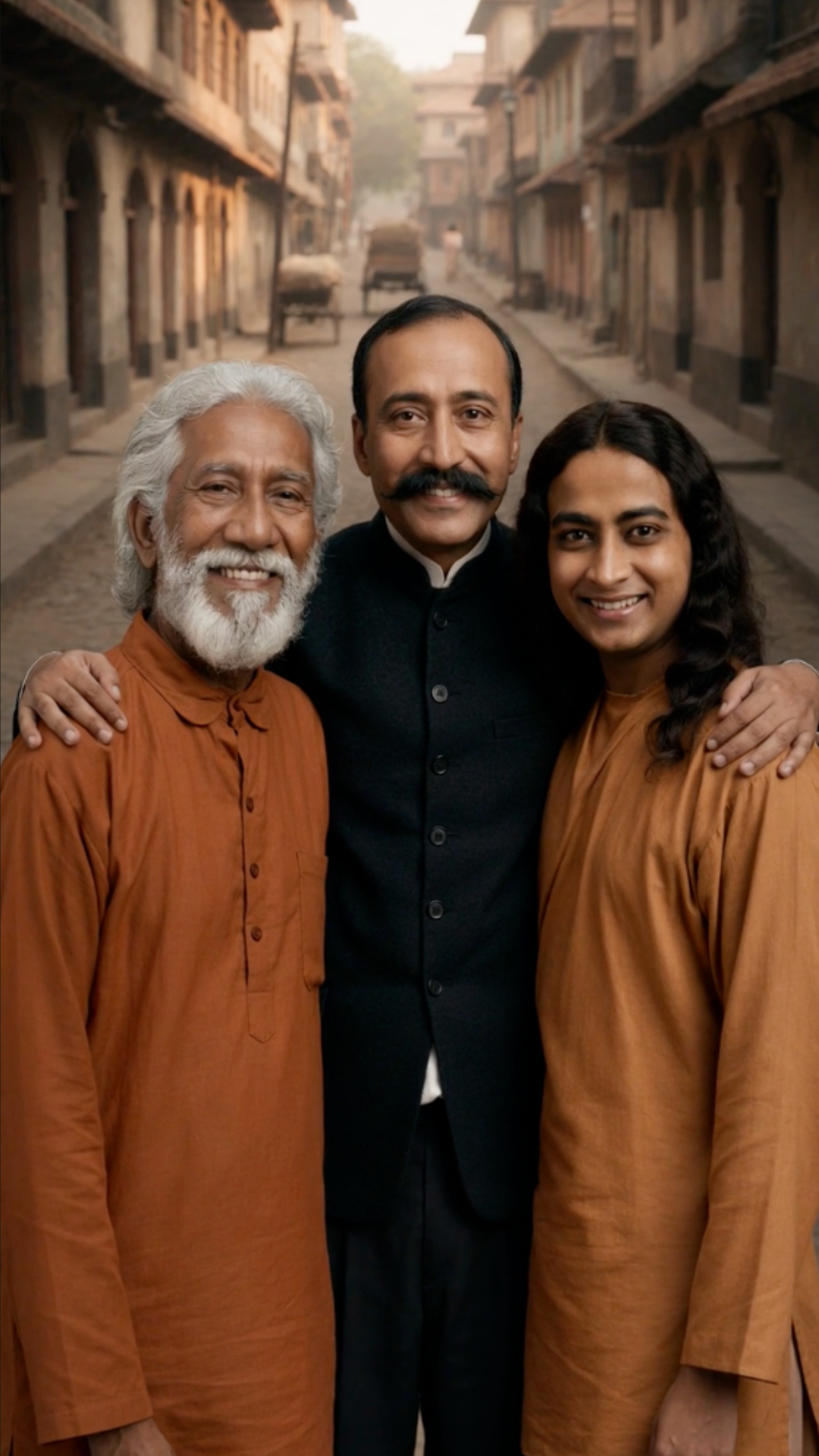
Two disciples of the same guru
The deep
esteem between Sri Yukteswar and Yogananda's father, both disciples of Lahiri Mahasaya.
Two disciples of the same guru
Chapter XII · "Years in my master's hermitage"
Sri Yukteswar used to hold Yogananda's father —Bhagabati Charan Ghosh— as an example of a
well-organized and balanced life. Both had been disciples of Lahiri Mahasaya and deeply
appreciated each other. On one occasion, when the father visits the hermitage hoping to hear
praise about his son, Sri Yukteswar solemnly enumerates a list of the young man's small
imperfections; the father runs off to tell him between tears and laughter. The scene reveals the
solid spiritual closeness between the two older men and the master's formative style, without
flattery.
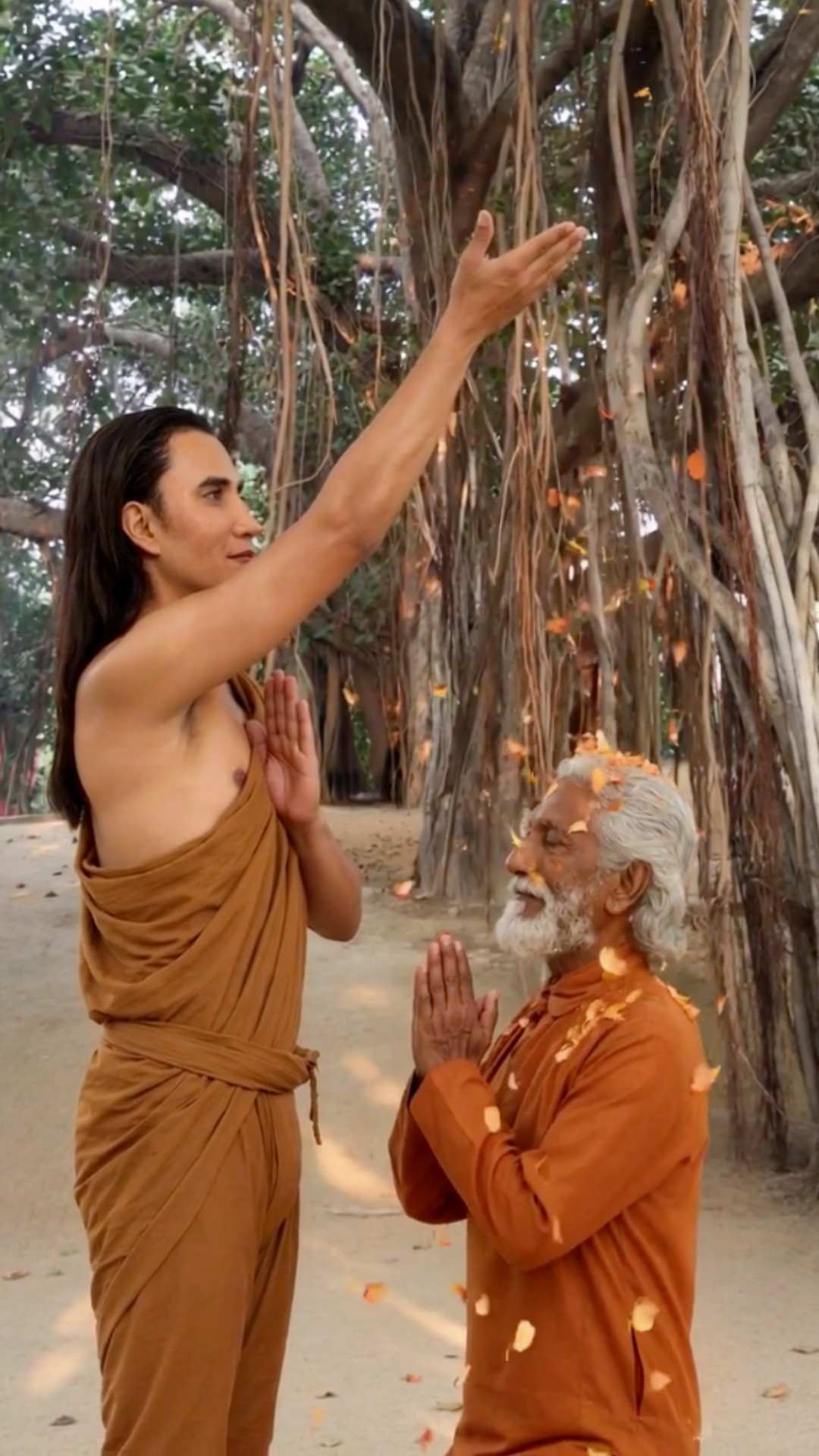
The first encounter with Babaji at the Kumbha
Mela
At the Kumbha Mela of Allahabad (1894), Sri Yukteswar is called before a radiant
guru beneath a tree: it is Babaji, who foretells his mission toward the West.
The first encounter with Babaji at the Kumbha Mela
Chapter XXXVI · "Babaji's Interest in the West"
On a quiet summer night in Serampore, Sri Yukteswar told Yogananda that he had been blessed
three times with the sight of the deathless guru, and that his first encounter took place at the
Kumbha Mela of Allahabad, in January 1894. He was not yet a swami, but he had already received
Kriya from Lahiri Mahasaya, who urged him to attend. Overwhelmed by the throng and somewhat
disillusioned —"this fair is nothing but a chaos of noise and beggars"—, he was crossing a
bridge by the Ganges when a tall sannyasi stopped him: "Sir, a saint is calling you". He
followed him to a tree in whose shade sat a guru of radiant presence, with dark, shining eyes:
it was Babaji. Reading his thoughts, Babaji praised his interest in the West and charged him
that East and West should together establish a "golden middle path" of activity and
spirituality. "Within a few years I will send you a disciple in yoga to spread this teaching in
the West", he promised. Years later, Sri Yukteswar would turn to Yogananda himself and say: "You
are the disciple Babaji promised to send me".
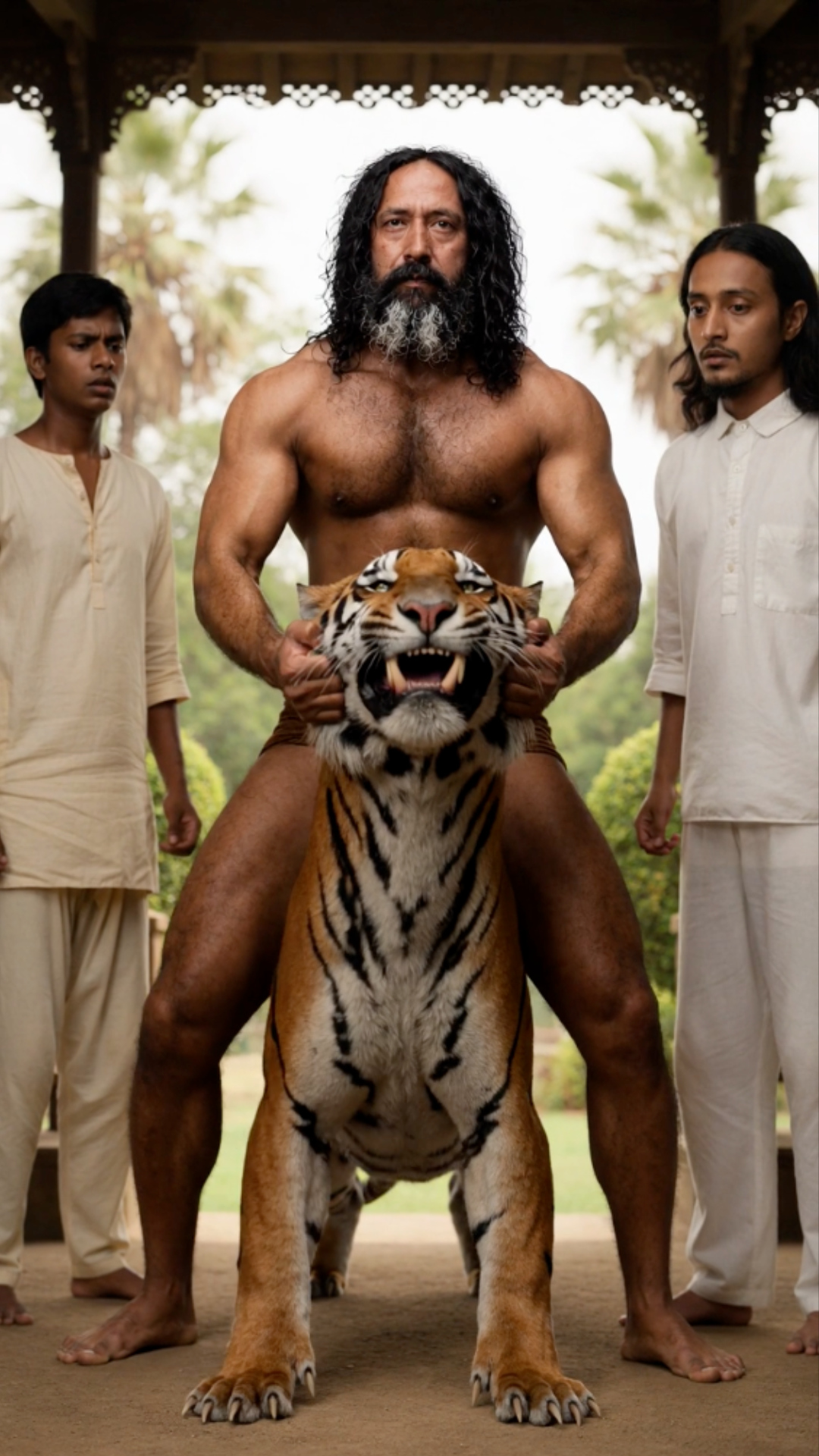
The Tiger Swami
Before becoming a monk,
Swami Sohong fought real Bengal tigers with his bare fists; a fulfilled prophecy would lead him
from the cage to the spiritual path.
The Tiger Swami
Chapter VI · "The Tiger Swami"
Moved by ardent youthful enthusiasm, Mukunda and his friend Chandi search in Bhowanipur, on the
outskirts of Calcutta, for a saint who in his premonastic life hunted and fought tigers with his
bare hands. After a long wait —a test of patience—, they find Swami Sohong seated on his bed: a
colossal body, with enormous biceps, naked save for a tiger skin at his waist and a gaze at once
of dove and tiger. "For me it is nothing to master tigers," he tells them. He confesses that his
body was weak at first, and that only his indomitable persistence in thoughts of strength
transformed him; there are, he adds, many kinds of tigers, and those that roam the jungles of
human desires are the ones truly worth conquering. Intoxicated by fame, he had ignored the
warning a saint sent through his father: if he did not stop, a tiger would cause him terrible
wounds and six months of grave illness, after which he would become a monk. The prophecy was
fulfilled to the letter in the arena of Cooch Behar, before the ferocious Raja-Begum. Healed at
last, the invincible tamer traded the cage for the spiritual path when his guru came to tell
him: "You have tamed enough tigers; come with me, and I will teach you to subdue the beasts of
ignorance that roam the jungles of the human mind."
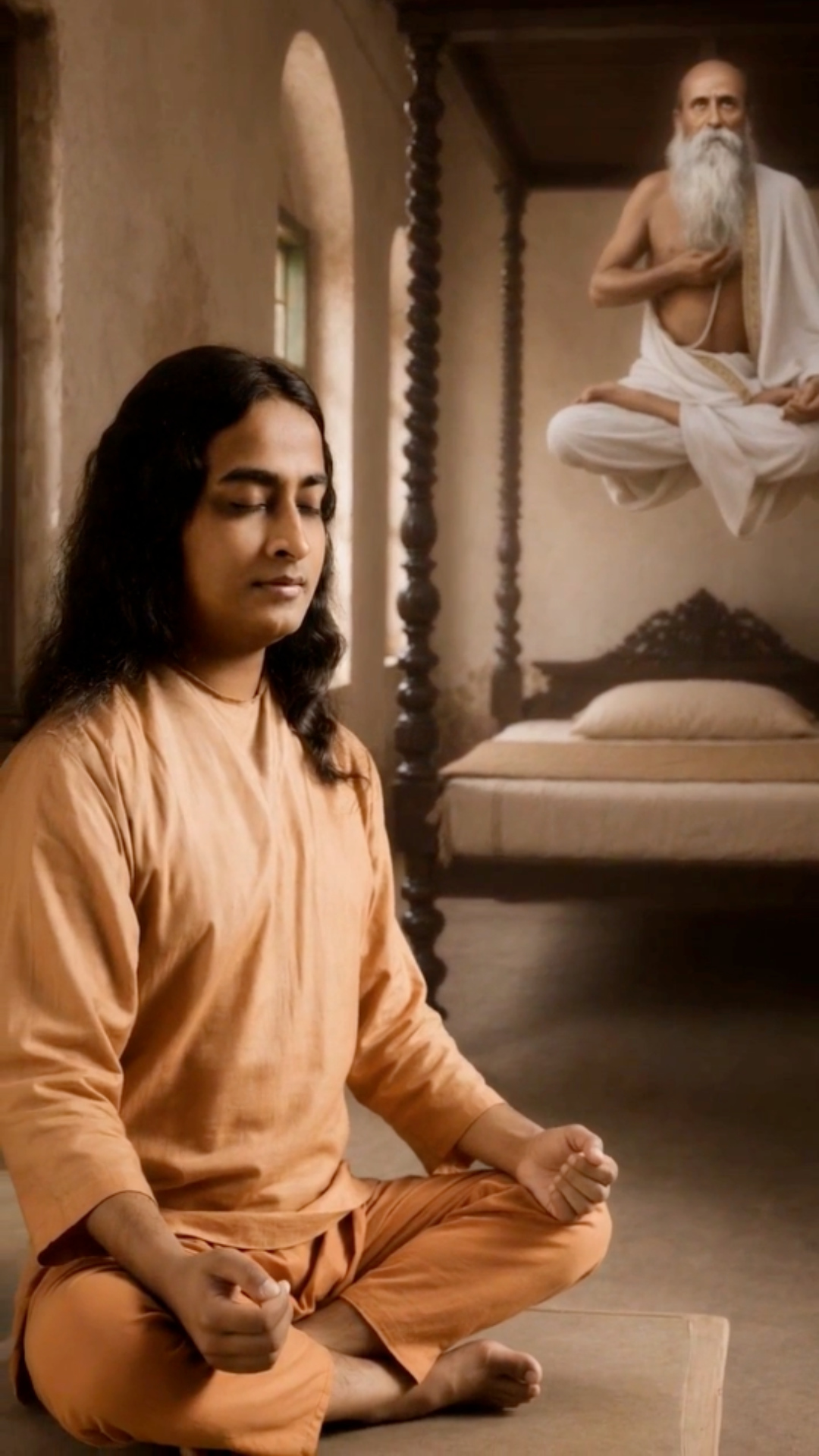
The Levitating Saint
Bhaduri Mahasaya,
secluded in his room on the Upper Circular Road, masters the pranayamas of Patanjali's eightfold
yoga until his body loses density and levitates in meditation.
The Levitating Saint
Chapter VII · "The Levitating Saint"
A friend tells Mukunda that he has seen a yogi hold himself in the air, several spans above the
ground; he guesses the name at once: Bhaduri Mahasaya, the saint of the Upper Circular Road,
whose house he often visits. A consummate master of the pranayamas of Patanjali's eightfold
yoga, on one occasion he performed Bhastrika Pranayama before him with such force that a storm
seemed to break loose in the room; then he stilled the breath and remained motionless in a high
state of superconsciousness, leaving an unforgettable aura of peace. As the body loses density
after certain pranayamas, the yogi can levitate. Secluded indoors for twenty years, he goes out
to the sidewalk only during the sacred festivals, where the poor await him, for he is famed for
his tender heart. Grave by nature yet full of humor —"most people prefer Jala Yoga, union with
food, to Dhyana Yoga, union with God"—, he had renounced a great family fortune since childhood:
"I have abandoned a few paltry rupees for a cosmic empire of infinite bliss," he would reply to
those who praised his sacrifice. He already corresponded with societies in America interested in
yoga and, with prophetic hints, foretold that Yogananda would one day carry India's teachings to
the West.
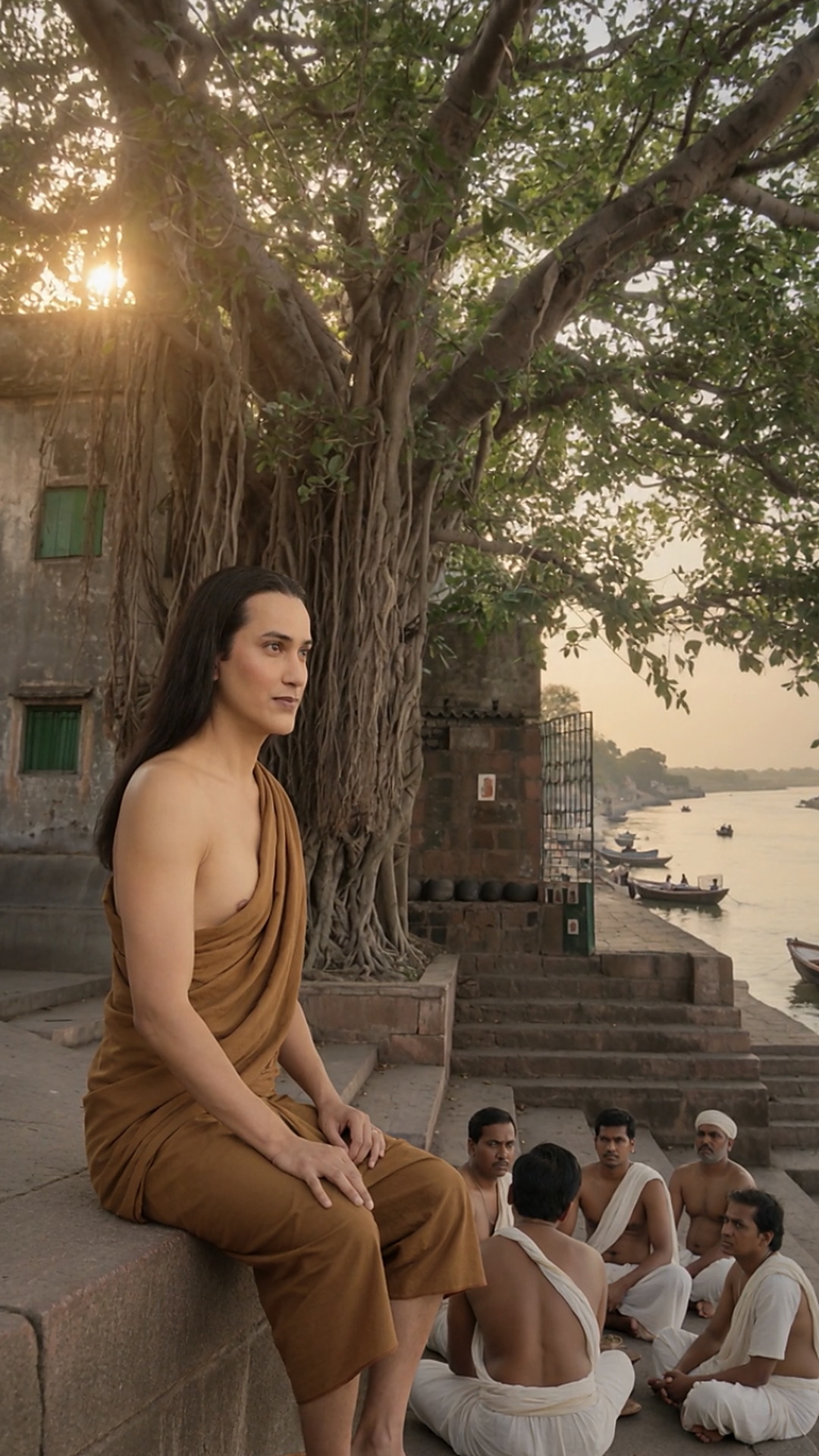
Babaji beneath the tree by the Ganges
Having
finished the treatise entrusted by Babaji, Sri Yukteswar finds him under a plantain tree by the
Ganges, surrounded by his disciples.
Babaji beneath the tree by the Ganges
Chapter XXXVI · "Babaji's interest in the West"
After completing the treatise that compared the Hindu Scriptures with the Bible, commissioned by
Babaji, Sri Yukteswar goes one morning to Rai Ghat to bathe in the Ganges. In the silence of the
place, an impulse makes him turn: beneath the shade of a plantain tree, by the shore, he finds
Babaji surrounded by his disciples. The immortal master greets him affectionately and thanks him
for the completed work. When Yukteswar runs to his nearby home to fetch fruit to offer them,
upon returning the small group has vanished without a trace. The scene reveals the delicacy and
apparent fleetingness with which Babaji manifests to his devotees.
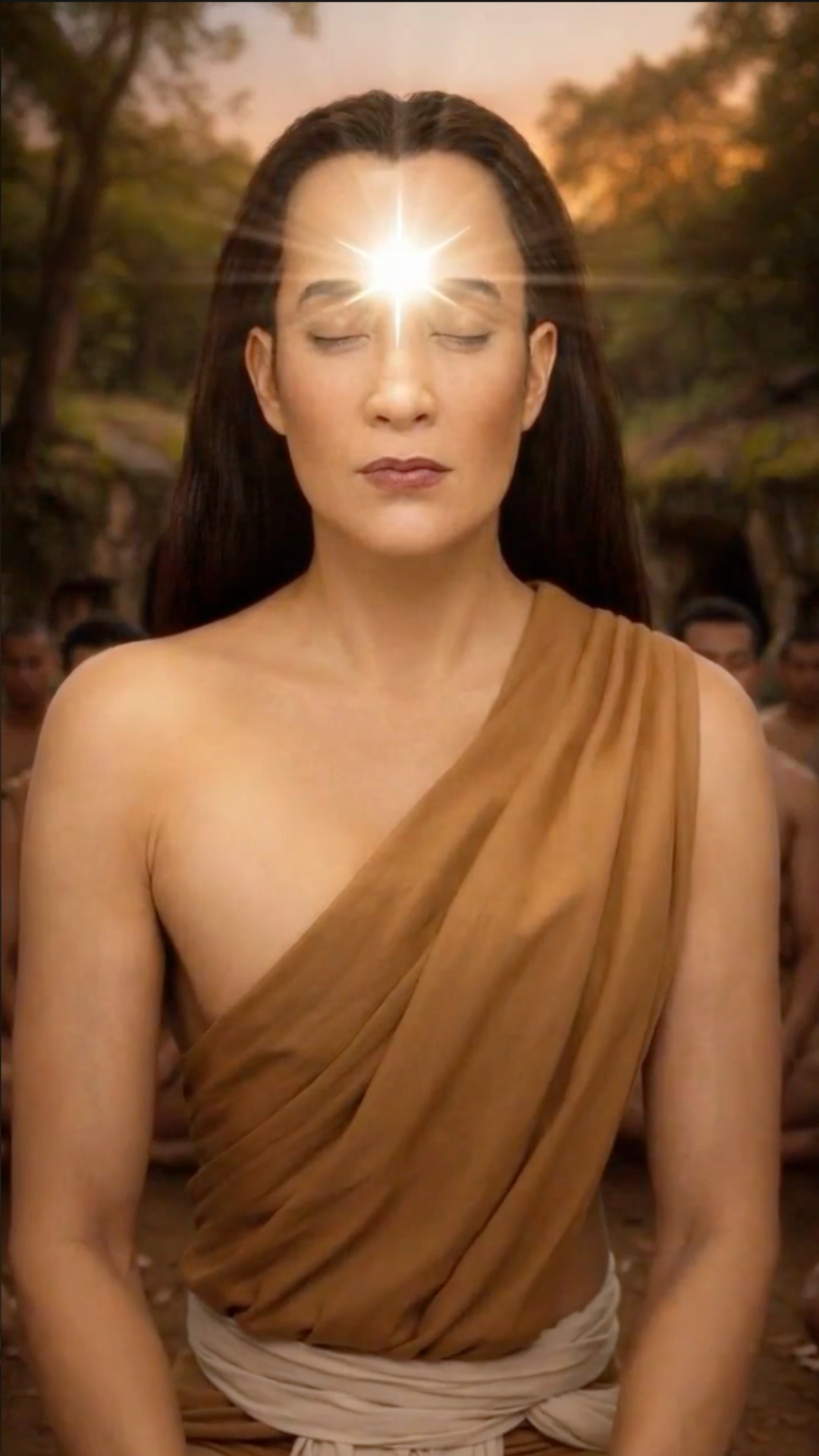
Babaji with his disciples
In the Himalayan
passes near Badrinarayan, the deathless Babaji is still alive, moving with his small band of
disciples and silently watching over the spiritual evolution of humanity.
Babaji with his disciples
Chapter XXXIII · "Babaji, the Yogi-Christ of Modern India"
In the Himalayan passes near Badrinarayan, the living presence of Babaji still blesses the earth:
the secluded master has retained his physical form for centuries, perhaps millennia, showing no
sign of age in a body that looks like that of a youth of twenty-five. He moves from peak to peak
with a small group of advanced disciples —among them a few accomplished Westerners—, sometimes by
astral means and sometimes on foot; when he decides to leave, he utters "Dera danda uthao" ("let
us lift camp") and the whole party moves on at once. He rarely eats, and only out of courtesy
occasionally accepts fruit or rice; he is seen or recognized only when he himself wishes it. As a
Mahavatar, his mission has been to help the prophets carry out their appointed work: he gave yoga
initiation to Shankara and to Kabir and, in the nineteenth century, to Lahiri Mahasaya, with whom
he revived the nearly lost art of Kriya. Babaji is in constant communion with Christ; together
they send out their vibrations of redemption and have planned the spiritual technique of
salvation for this age, inspiring nations to banish wars, racial hatreds, sectarianism, and the
evils of materialism. His purpose is to spread self-realization through yoga in both East and
West, laboring always in obscure and silent humility.
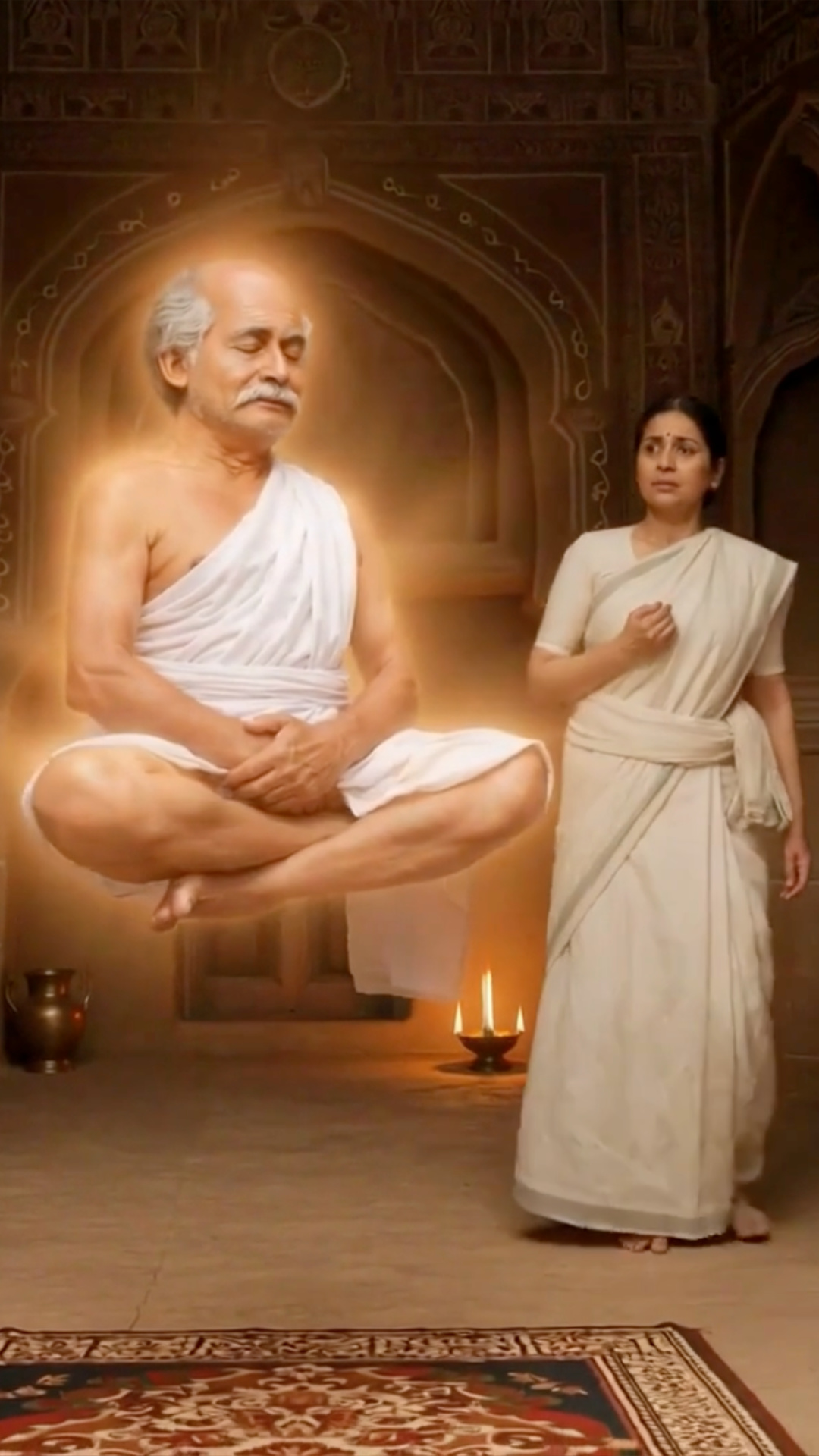
Lahiri is discovered
One night, in her own
room, Kashi Moni awakens and sees her husband, Lahiri Mahasaya, suspended in the air in the
lotus posture, surrounded by angels who revere him.
Lahiri is discovered
Chapter XXXI · "An Interview with the Sacred Mother"
Many years passed before Kashi Moni came to understand the true divine stature of her husband.
One night, in the small room the two shared, she had a vivid dream in which glorious angels
floated above her with unimaginable grace; the vision was so real that she awoke to find the room
strangely bathed in a dazzling light. Her husband, in the meditative lotus posture, hung
suspended in mid-air, surrounded by angels who revered him with joined palms and an attitude of
suppliant dignity. Utterly astonished, she believed she was still dreaming, until Lahiri Mahasaya
told her: "Woman, you are not dreaming; forget your dream forever." As he descended slowly to the
floor, she prostrated at his feet and begged forgiveness for having regarded him as a mere
husband, imploring him to accept her as his disciple. From that night on the master never again
slept in her room: he remained on the ground floor with his disciples, and offered his consort
initiation into Kriya Yoga.
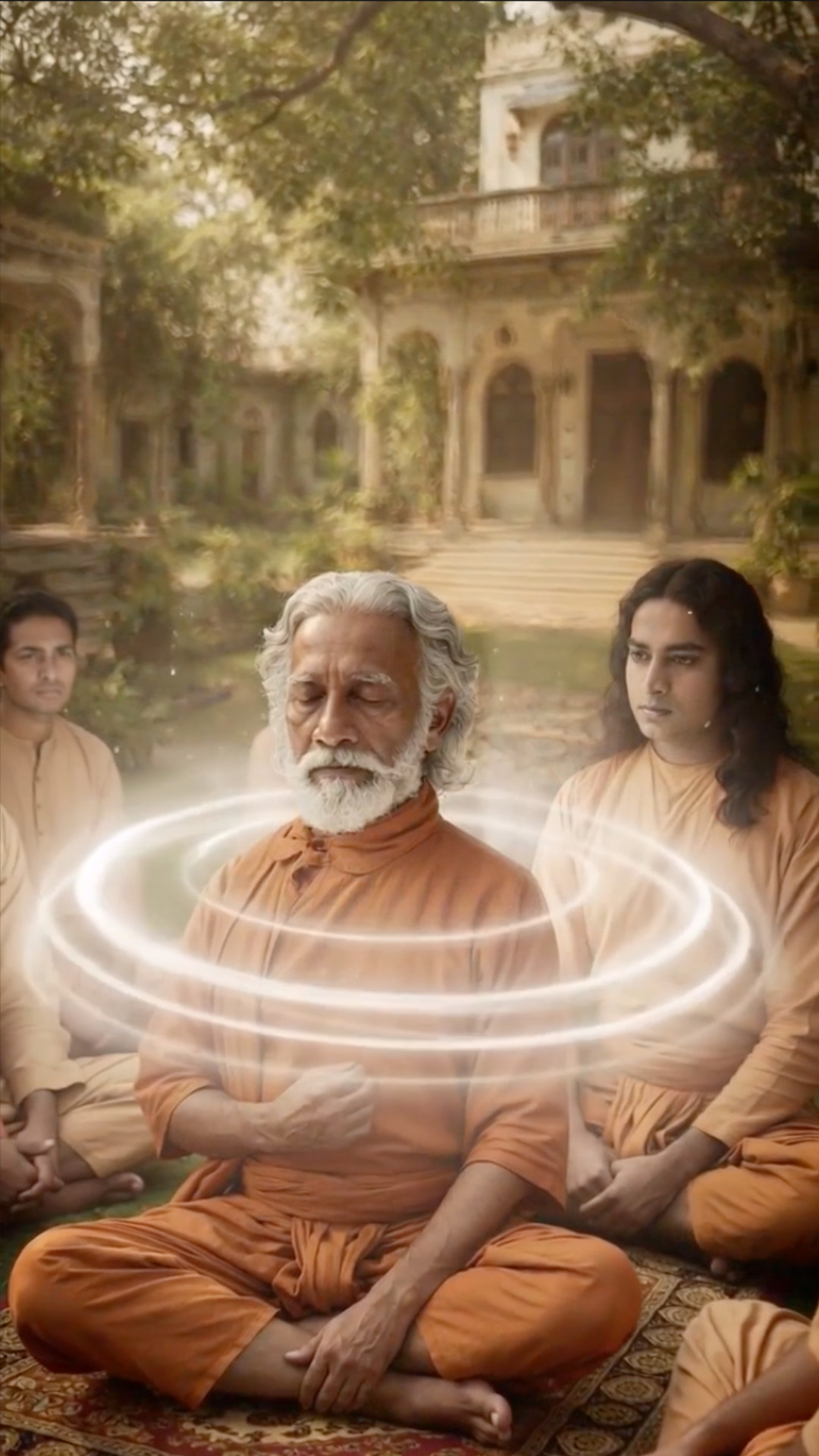
Meditating together
At the Serampore
hermitage, Sri Yukteswar would wake before dawn to enter samadhi and devoted the quiet hours of
the night to interpreting the Scriptures and guiding the meditation of his disciples.
Meditating together
Chapter XII · "Years in my master's hermitage"
In the ancestral mansion of Serampore, turned into a hermitage, daily life flowed gently to the
rhythm of spiritual discipline. Sri Yukteswar would wake before dawn and, reclining or seated on
his bed, enter the state of samadhi; then came the long morning walks along the Ganges, in which
his rich, sonorous voice distilled true wisdom. The quiet hours of the night often brought forth
his discourses, treasures that defy time, each utterance measured and chiseled, so much so that
the young Yogananda was aware of standing before a living manifestation of God. In the peaceful
hour of twilight, seated at his feet, the disciple listened as the master incomparably
interpreted the ancient texts, and it was not unusual for a philosophical discussion to last
until the new dawn. There he imparted to Yogananda the initiation into Kriya Yoga, whose touch
opened within his being a great light like the radiance of countless suns burning together.
Between meditation and teaching, Sri Yukteswar trained his own to sustain superconsciousness
amid every distraction, until sound and sight opened onto worlds more beautiful than the lost
Eden.
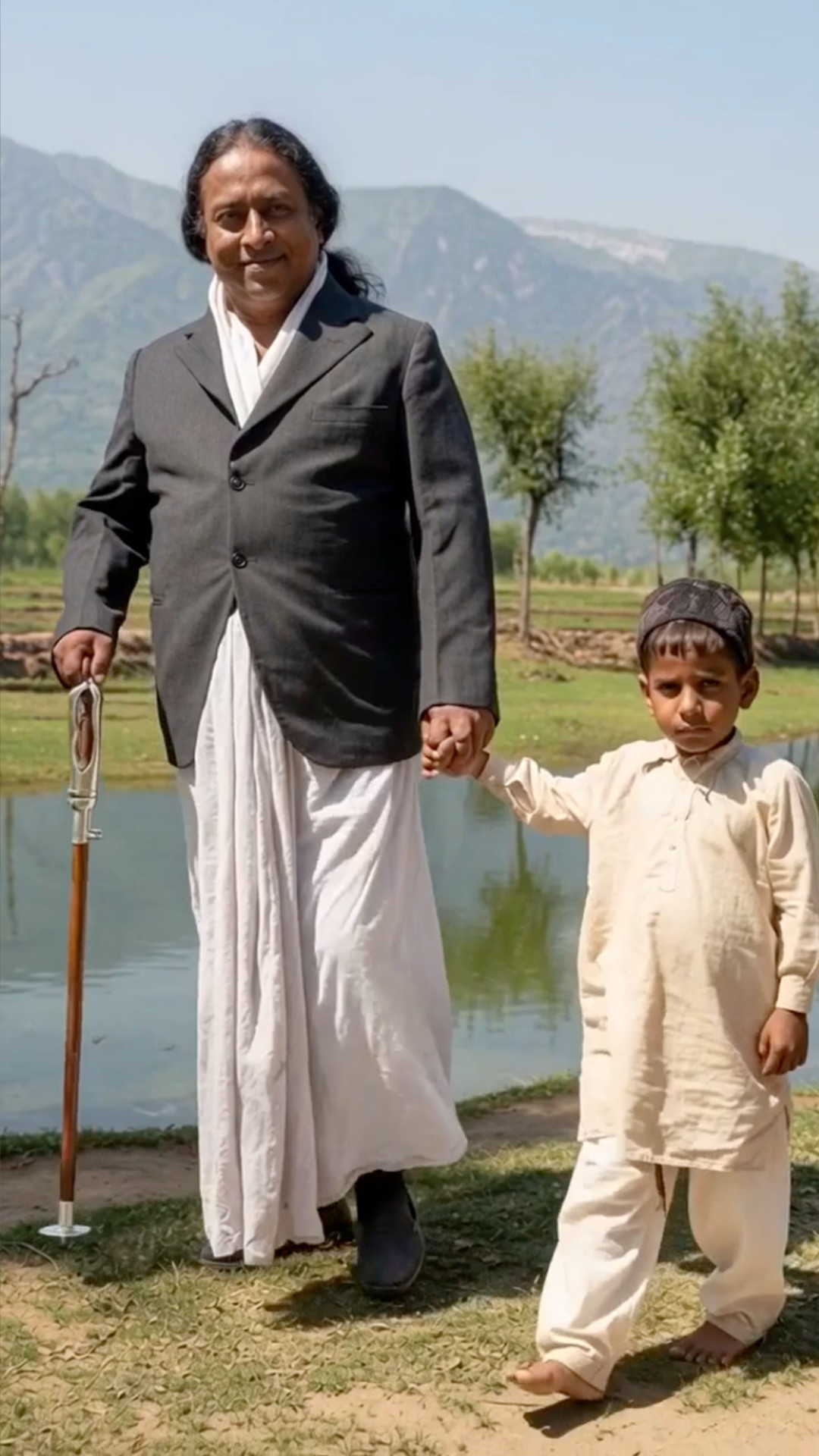
Yogananda and the child
One of the most
beloved images from Paramahansa Yogananda's collection of prints, which many devotees keep on
our altar, here recreated and animated with artificial intelligence.
Yogananda and the child
Devotional print from Self-Realization Fellowship · Recreated and animated with artificial intelligence
This is one of the cherished images from the collection of Paramahansa Yogananda prints that
Self-Realization Fellowship has preserved over the years, and which so many devotees have longed
to keep on our altar as a reminder of the guru's tenderness. In it, the master is seen beside a
child, in a serene scene by the river that conveys the sweetness, protection, and unconditional
love with which Yogananda welcomed every soul. To give new life to this beloved picture, we have
recreated it with artificial intelligence and turned it into a short animated video, in the hope
that, seeing it in motion, we may feel even closer the loving presence of our Gurudeva.
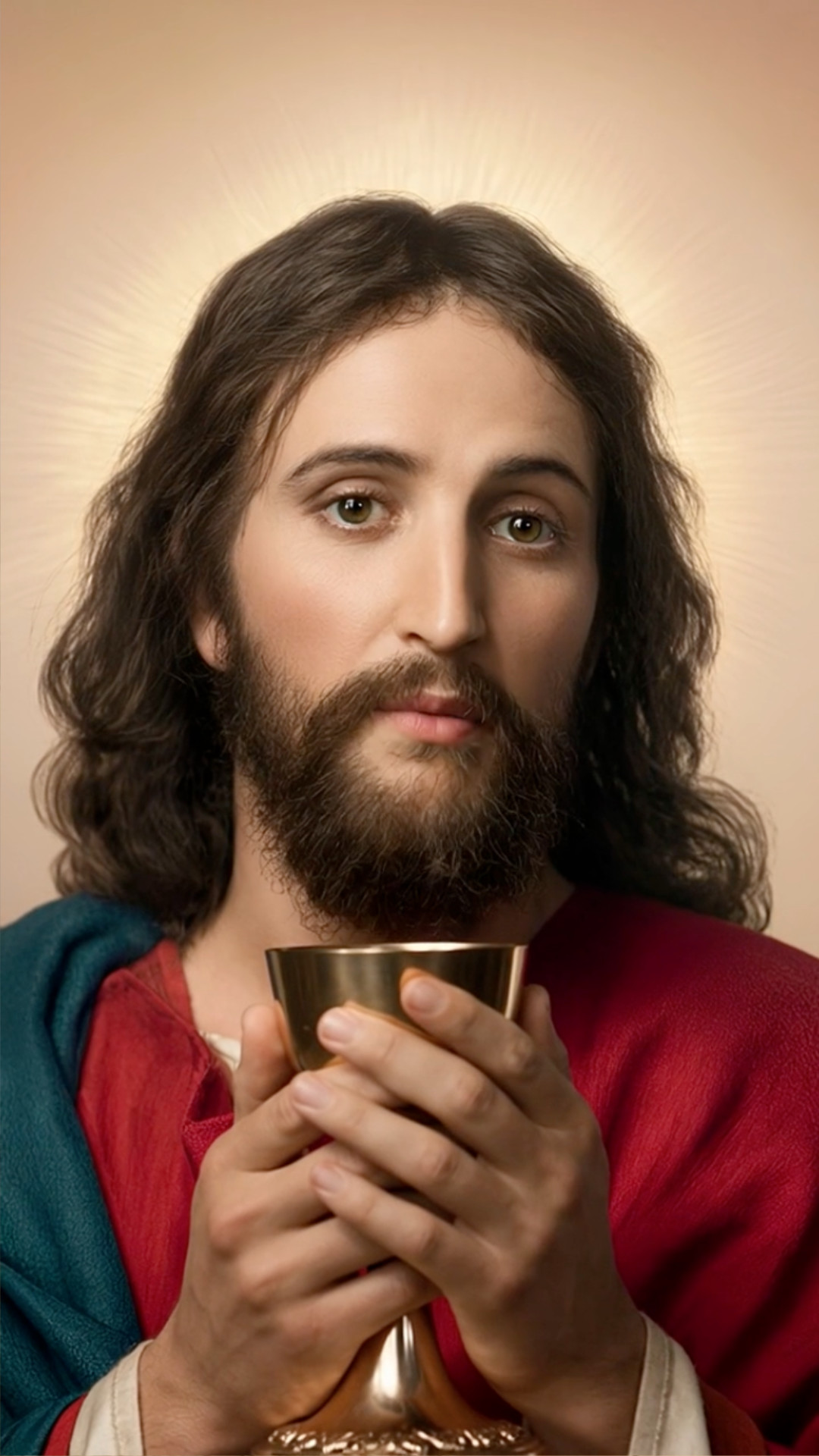
The Second Coming of Christ
While dictating
his interpretation of the New Testament at Encinitas, Yogananda begged Christ to reveal the true
meaning of his words; one night, Jesus appeared to him in a radiant body to confirm it.
The Second Coming of Christ
Chapter XLIX · "The Years 1940-1951"
One of the happiest periods of Paramahansa Yogananda's life passed while he was dictating, for
publication in Self-Realization Magazine, his interpretation of a portion of the New Testament.
During that time he fervently implored Christ to reveal to him the true meaning of his words, so
often misinterpreted over twenty centuries. One night, as he prayed in silence, an opalescent
light flooded his study at the Encinitas hermitage and Jesus Christ appeared before him in a
radiant body, with the semblance of a young man of about twenty-five, his long hair parted in the
middle and encircled by a shining golden halo. From his ever-changing, luminous eyes streamed the
wisdom that upholds the countless worlds. A Holy Grail then descended from his mouth to
Yogananda's lips and returned to him, and the Master spoke words of such beautiful and personal
meaning that the yogi treasured them in the depths of his heart. In them, Christ confirmed that
his interpretation of the Scriptures was true, with the moving words: "You have drunk of the same
cup from which I drank."
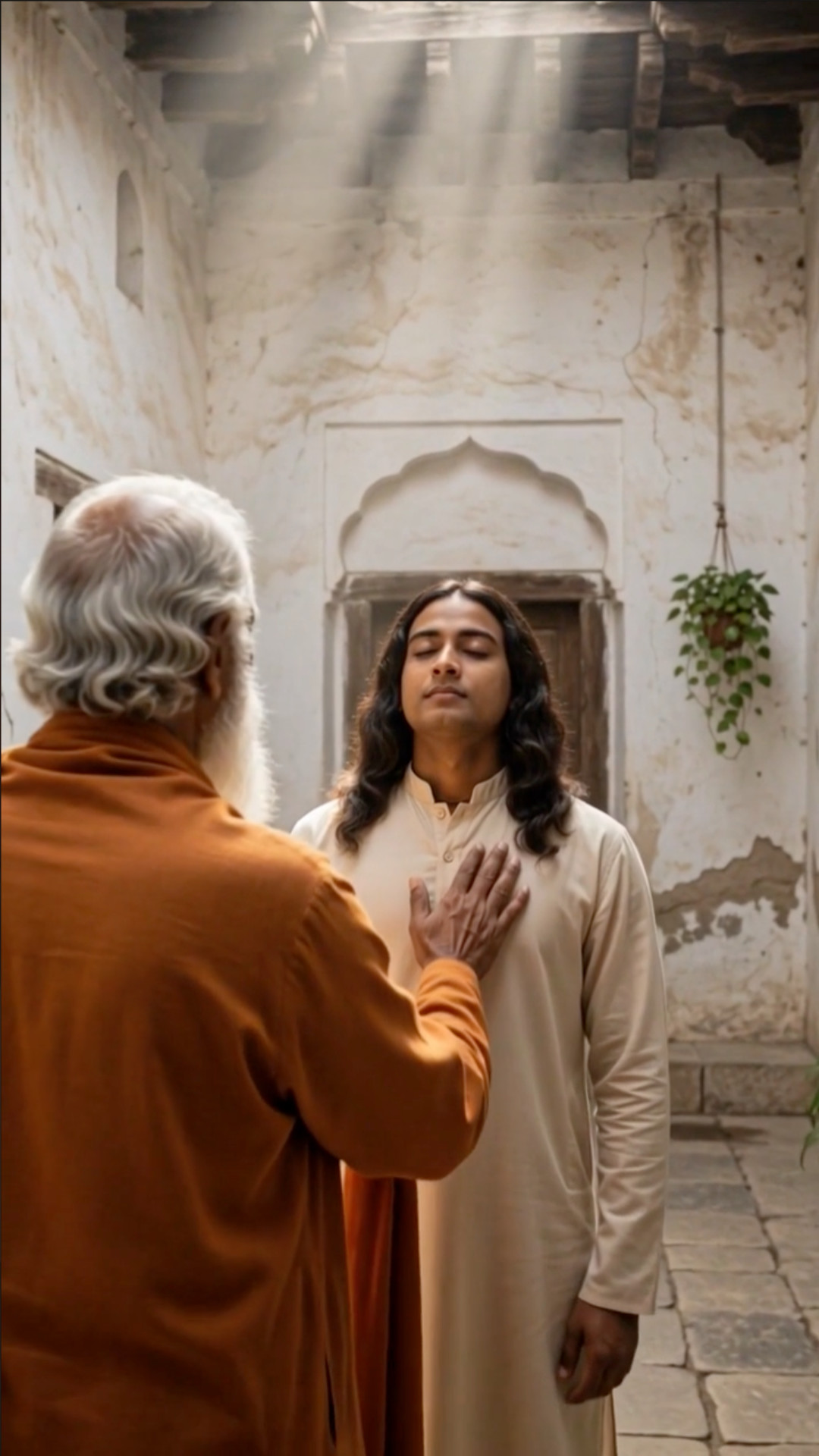
The samadhi of cosmic consciousness
In the Serampore hermitage, Sri Yukteswar gently strikes Mukunda's chest, just above the heart, and ushers him into the ocean of light of cosmic consciousness, where his being expands to embrace the entire universe.
The samadhi of cosmic consciousness
Chapter XIV · "An Experience in Cosmic Consciousness"
One morning at the Serampore hermitage, as Mukunda —the future Paramahansa Yogananda— tried to meditate with a mind restless as leaves in a storm, Sri Yukteswar called him to his side. "The mountains cannot give you what you want," he said tenderly; "your soul's desire shall be fulfilled." Then he struck him gently on the chest, a little above the heart. At once the disciple's body grew still, the breath left his lungs, and his sense of identity was no longer confined to the flesh but embraced every atom around him. He beheld the whole neighborhood in a single spherical, all-perceiving glance; objects quivered and melted into a sea of light, and he heard the AUM, the creative vibration of the universe. An ocean of joy broke upon the endless shores of his soul. When his breath returned, the master warned him: "You must not become intoxicated with ecstasy; much work yet remains for you in the world," teaching him the secret of a balanced life.
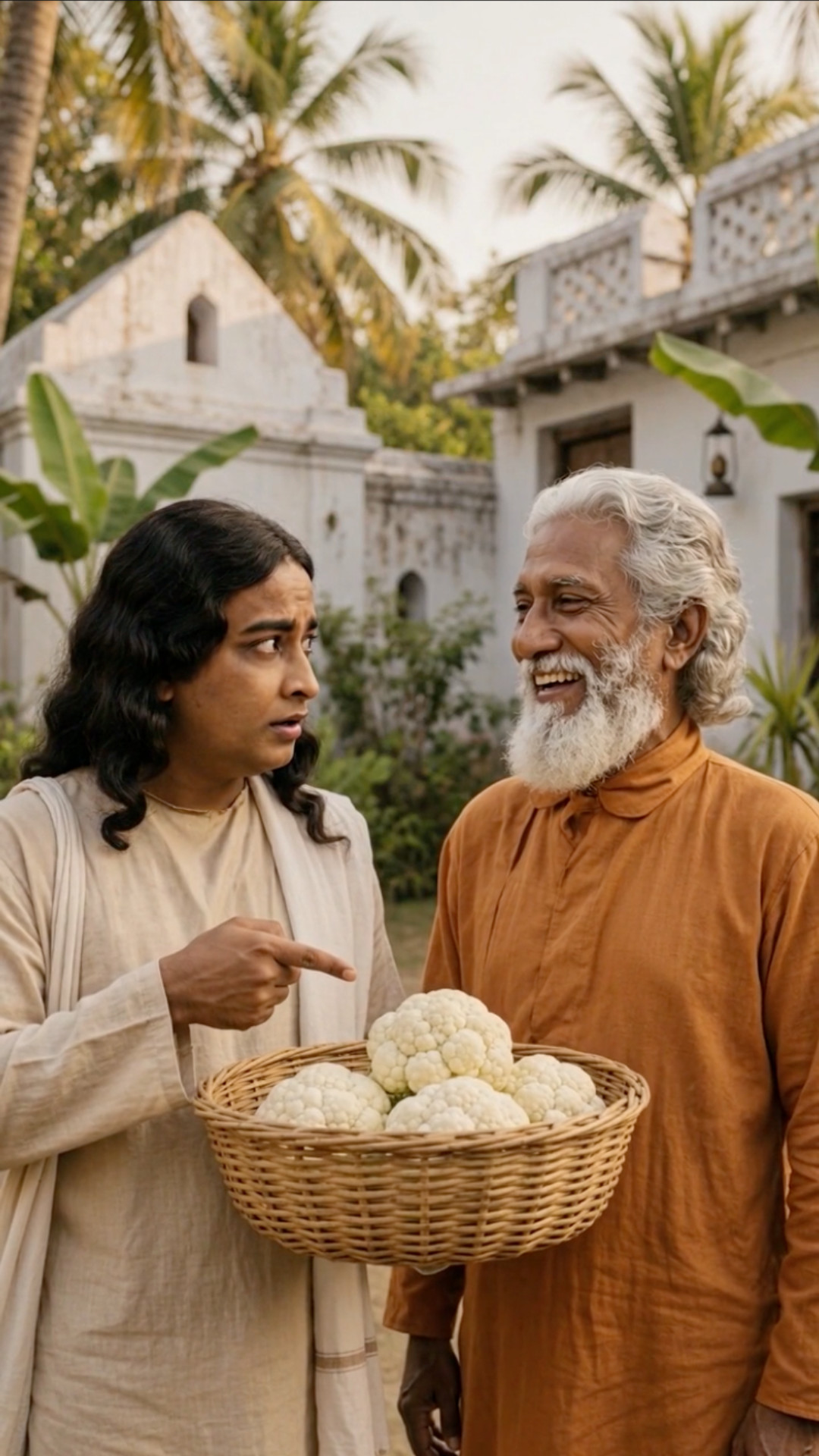
The cauliflower robbery
On holiday at the Puri hermitage, Mukunda hides beneath his bed six cauliflowers he has grown with his own hands. Reading his carelessness and another man's thoughts, Sri Yukteswar foretells that they will soon be only five.
The cauliflower robbery
Chapter XV · "The Cauliflower Robbery"
During his summer holidays at the seaside hermitage of Puri, on the Bay of Bengal, Mukunda presents Sri Yukteswar with six cauliflowers grown by his own hands and tucks them beneath his bed. The next morning, on the way to the beach, the master asks whether he locked the hermitage's back door; the disciple believes he did, but Sri Yukteswar announces with a smile that, because of his negligence, "your six cauliflowers will soon be only five." He then points to a road and predicts that a man will soon pass by who will be the instrument of his punishment. A half-mad peasant appears and, just as the master foretold, enters through the open door and walks out with one of the prized cauliflowers. Shaking with laughter from head to foot, Sri Yukteswar explains that he had caught the poor man's craving and guided his steps to the ill-guarded vegetable, showing, like a perfect human radio, the omnipresence of a mind attuned to God.
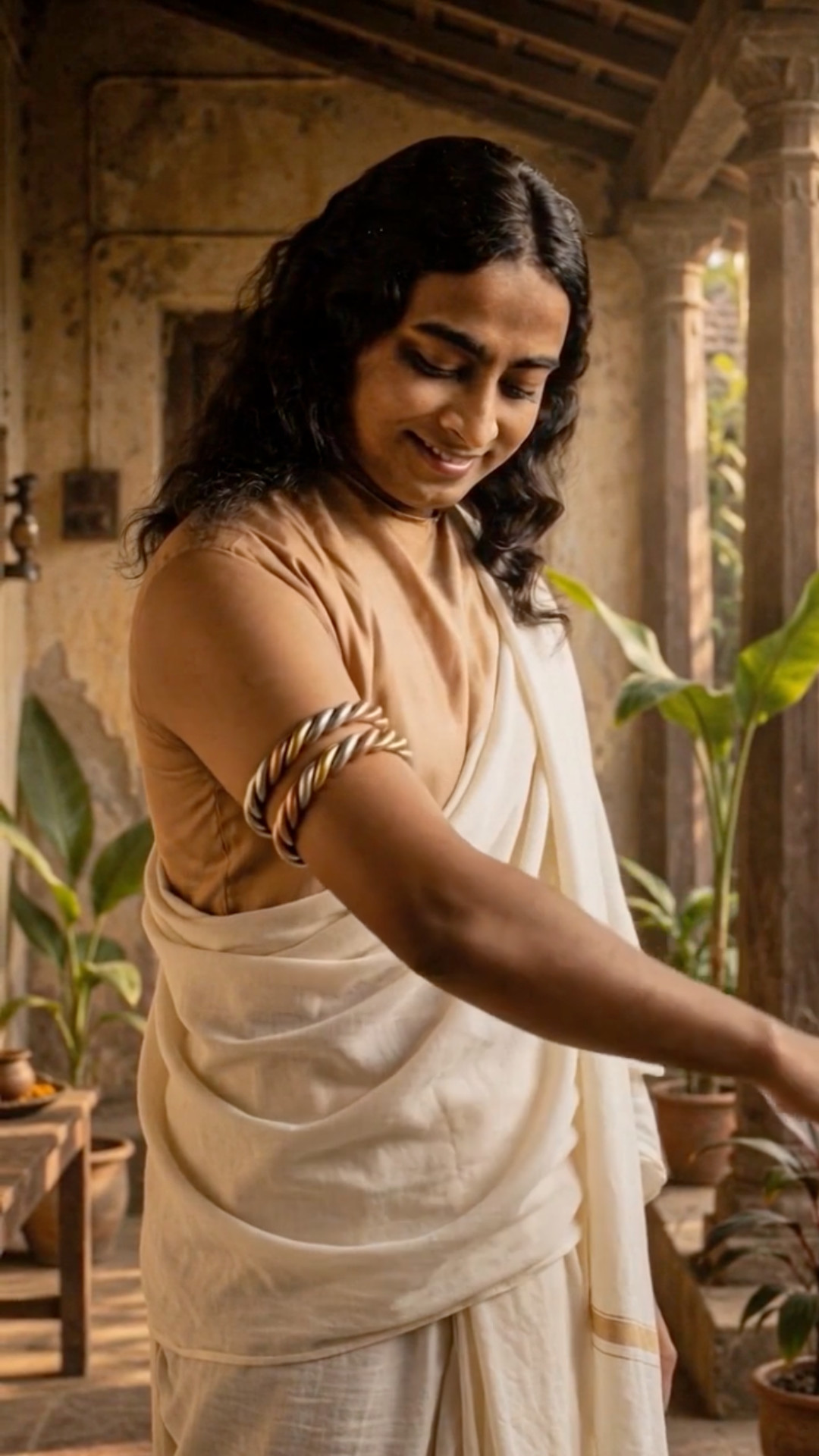
The astrological bangle
Sri Yukteswar advises Mukunda to wear an astrological bangle of pure metals —not out of superstition, but as a preventive measure against a liver ailment he foresees for the coming month.
The astrological bangle
Chapter XVI · "Outwitting the Stars"
"Mukunda, why don't you wear an astrological bangle?" Sri Yukteswar asks one day. The disciple objects that he does not believe in astrology, and the master replies that it is not a matter of belief but of scientific truth: astrology is the study of man's response to planetary stimuli, and the stars merely send radiations that channel the balance of cause and effect set in motion by our own karma. The wise man, he explains, masters his planets by transferring his allegiance from creation to the Creator. Even so, while the journey lasts one does well to use every aid: the ancient rishis discovered that pure metals emit an astral light that counteracts the negative tendencies of the planets, just as a copper lightning rod protects a house. Sri Yukteswar advises a bangle of gold, silver and copper, and warns him that within a month his liver will begin to trouble him; with the bangle, an ailment that would have lasted six months will be shortened to twenty-four days.
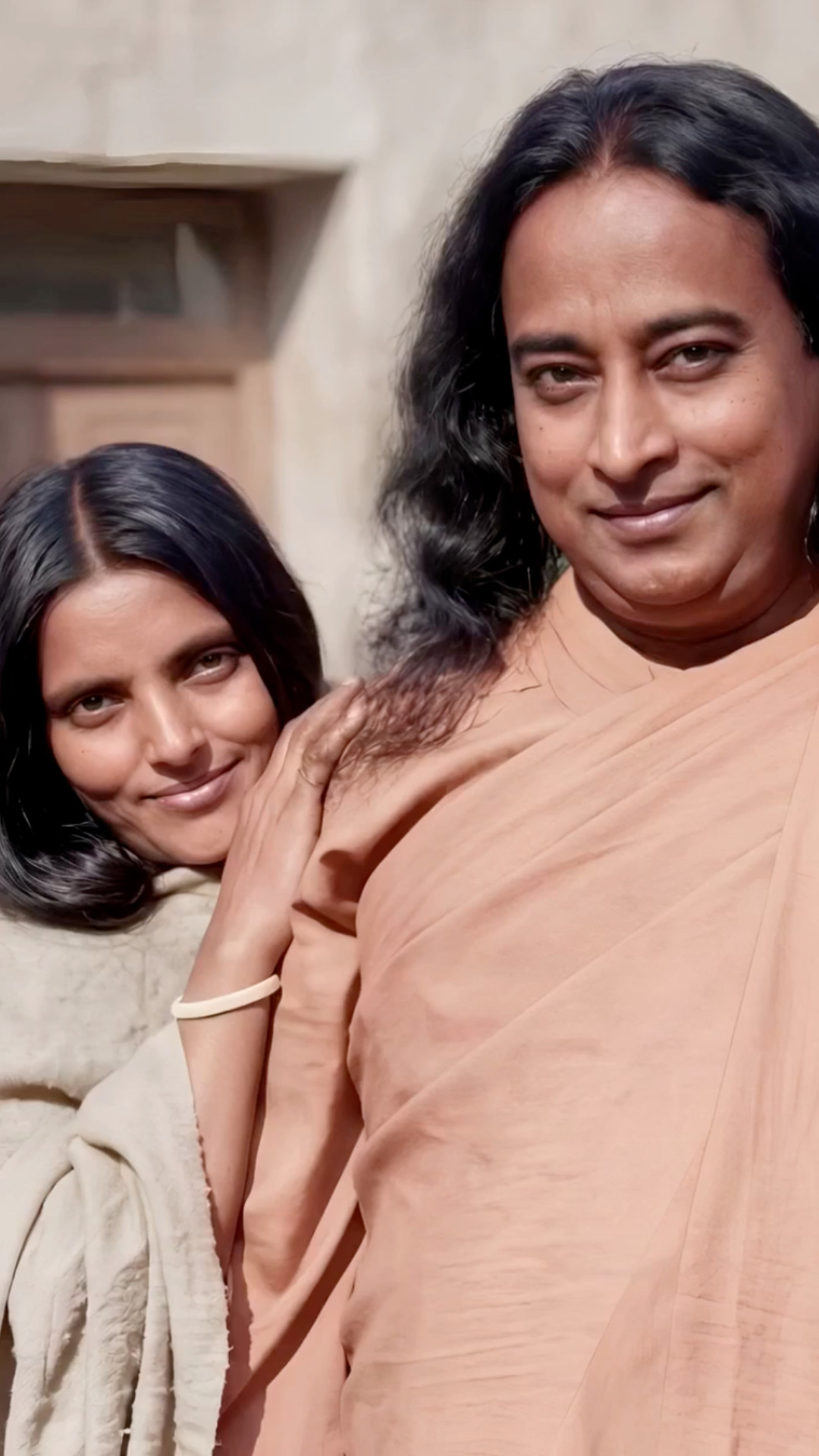
Meeting Anandamayi Ma
On a Calcutta street, the saint Anandamayi Ma, absorbed in samadhi, steps down from her car and embraces Yogananda, whom she has never met: "Father, you have come!"
Meeting Anandamayi Ma
Chapter XLV · "The Bengali 'Joy-Permeated Mother'"
Before returning to America, Yogananda goes to a house in Bhowanipur, Calcutta, to meet Nirmala Devi, the saint known throughout India as Anandamayi Ma, the "Joy-Permeated Mother." On arriving he finds her standing in an open car, blessing some hundred disciples and about to depart. Though they have never met, the saint steps down, comes toward him and, throwing her arms about his neck, exclaims: "Father, you have come!" Yogananda realizes at once that she is in a deep state of samadhi, conscious only of her changeless soul, and that from that plane she joyously greets a fellow devotee of God. Her small face is radiant with an ineffable joy, and a dot of sandalwood on her brow symbolizes the ever-open spiritual eye. Her own disciples feed her by hand, for she scarcely tends to her body and passes whole days in ecstasy. "My consciousness has never associated itself with this temporary body," she confides; "before I came into this world, I was the same; and I am the same still."
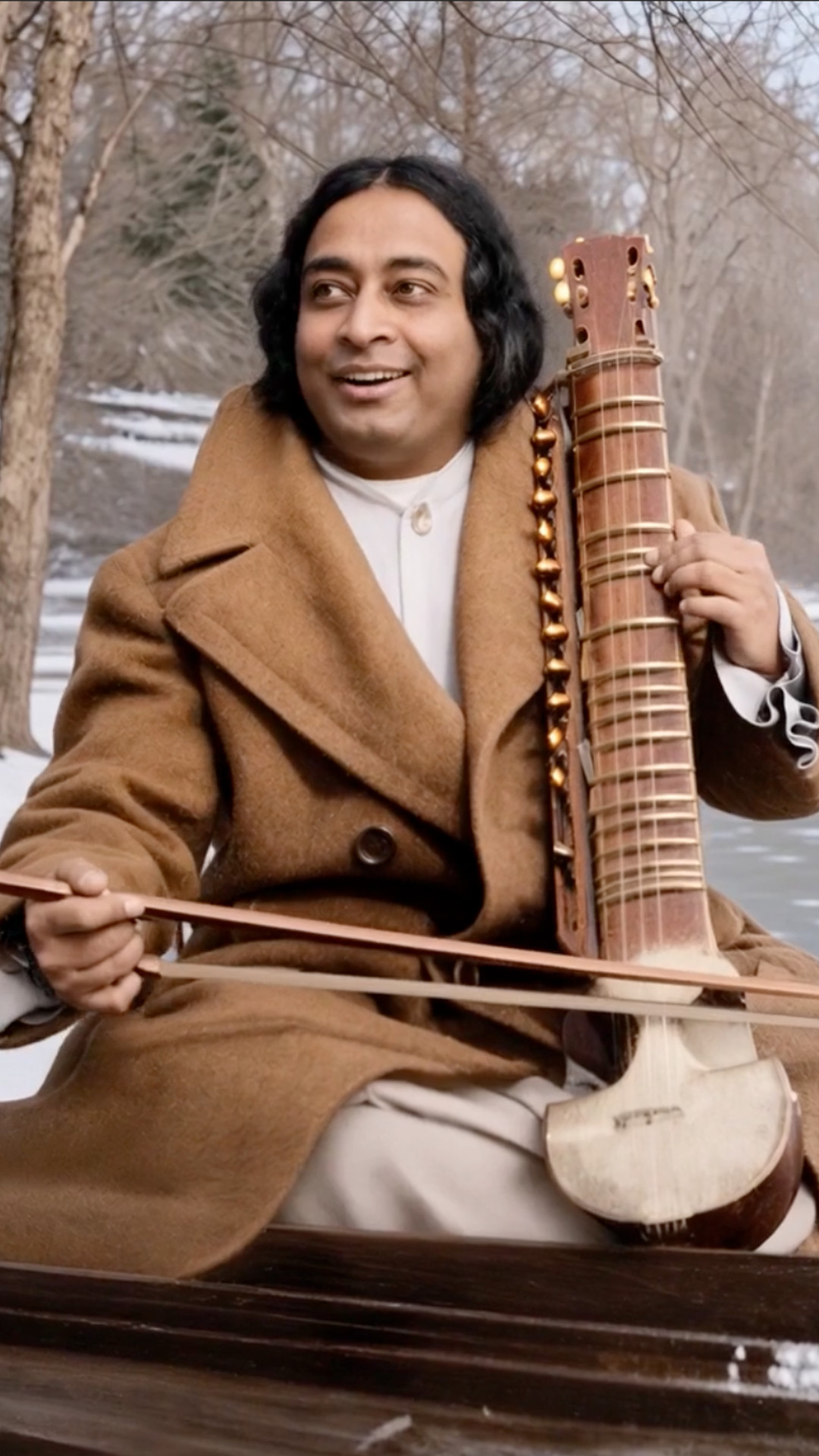
The master playing
Devotional song was one of Yogananda's great joys. In 1926, at Carnegie Hall in New York, he led three thousand Westerners in chanting an ancient Hindu chant together for one hour and twenty-five minutes.
The master playing
Chapter XLVIII · "At Encinitas in California"
For Yogananda, singing and making devotional music was a direct path to the heart of God. He gathered his favorite chants —among them two of Sri Yukteswar's favorites, "Awake, awake, O my Saint" and "Desire, my great enemy," ancient Sanskrit hymns, old Bengali songs, and compositions of his own— convinced that "music is a universal language." He put that conviction to the test on April 18, 1926, during a public lecture at Carnegie Hall in New York. One student feared the Eastern chant "O God Beautiful" would draw a rain of rotten tomatoes; yet for one hour and twenty-five minutes its notes rang out unbroken from the throats of three thousand people, whose hearts were lifted in simple joy. That very night, among those lovingly chanting the name of the Lord, numerous divine healings took place.
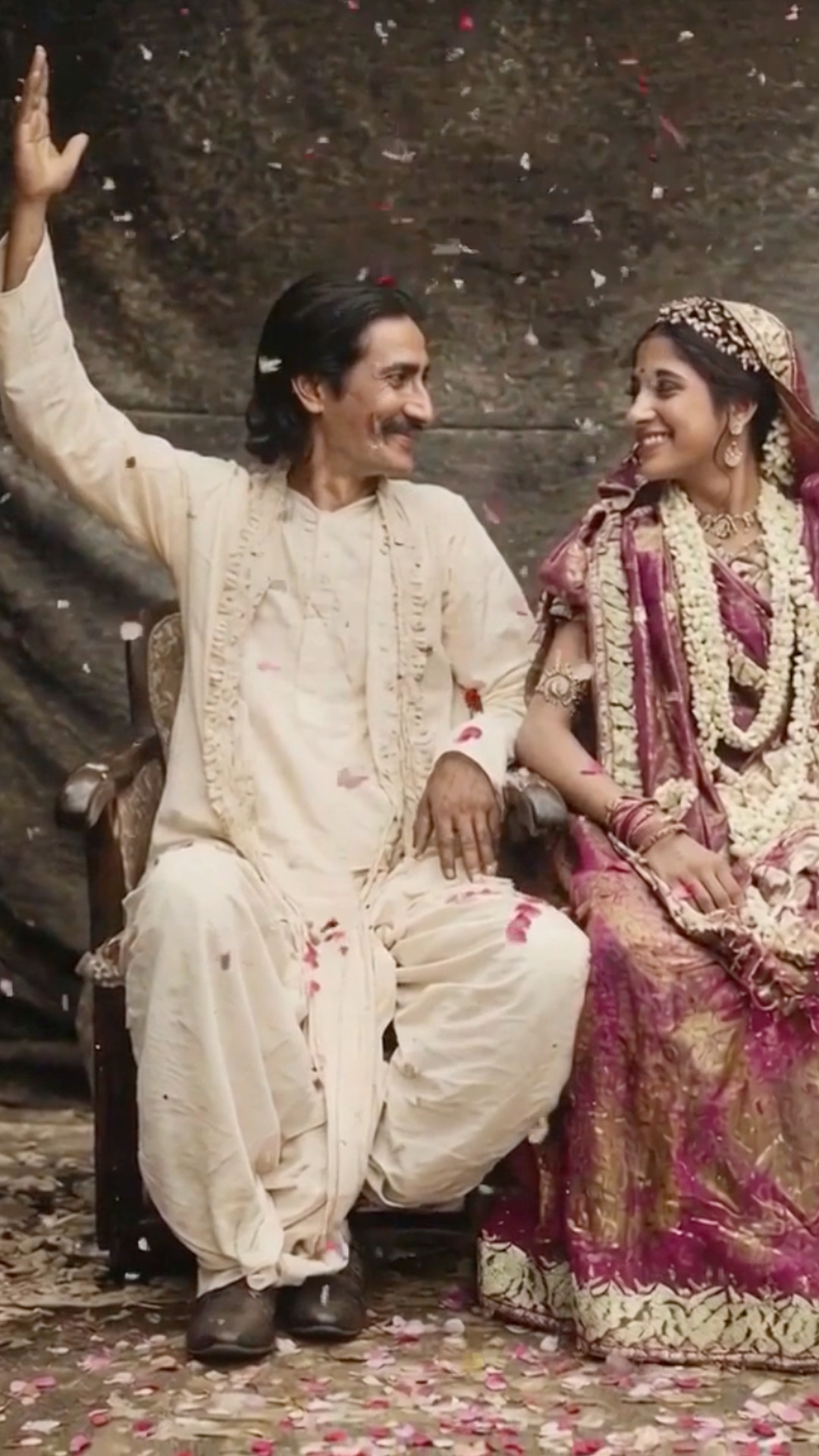
Yukteswar at his daughter's wedding
On his first night at the hermitage, Sri Yukteswar confides his story to Yogananda: he had been a householder, had a daughter —now married— and entered the Swami Order only after being widowed.
Yukteswar at his daughter's wedding
Chapter XII · "Years in my master's hermitage"
On the first night Mukunda spent under his guru's roof in Serampore, squatting on a mat beside the tiger skin as the familiar stars drew near the balcony, he asked: "Guruji, tell me something of your life." Sri Yukteswar answered simply: his family name had been Priya Nath Karar; he had been born there in Serampore, son of a prosperous merchant who left him the ancestral mansion, now his hermitage. Very young he took on the responsibilities of a householder, and had a daughter, now married. His middle years were blessed by the guidance of Lahiri Mahasaya, and only after his wife's death did he enter the Order of Swamis, receiving the name Sri Yukteswar Giri. Behind those "simple annals," the Master smiled, lay hidden the true characteristics of the inner man.
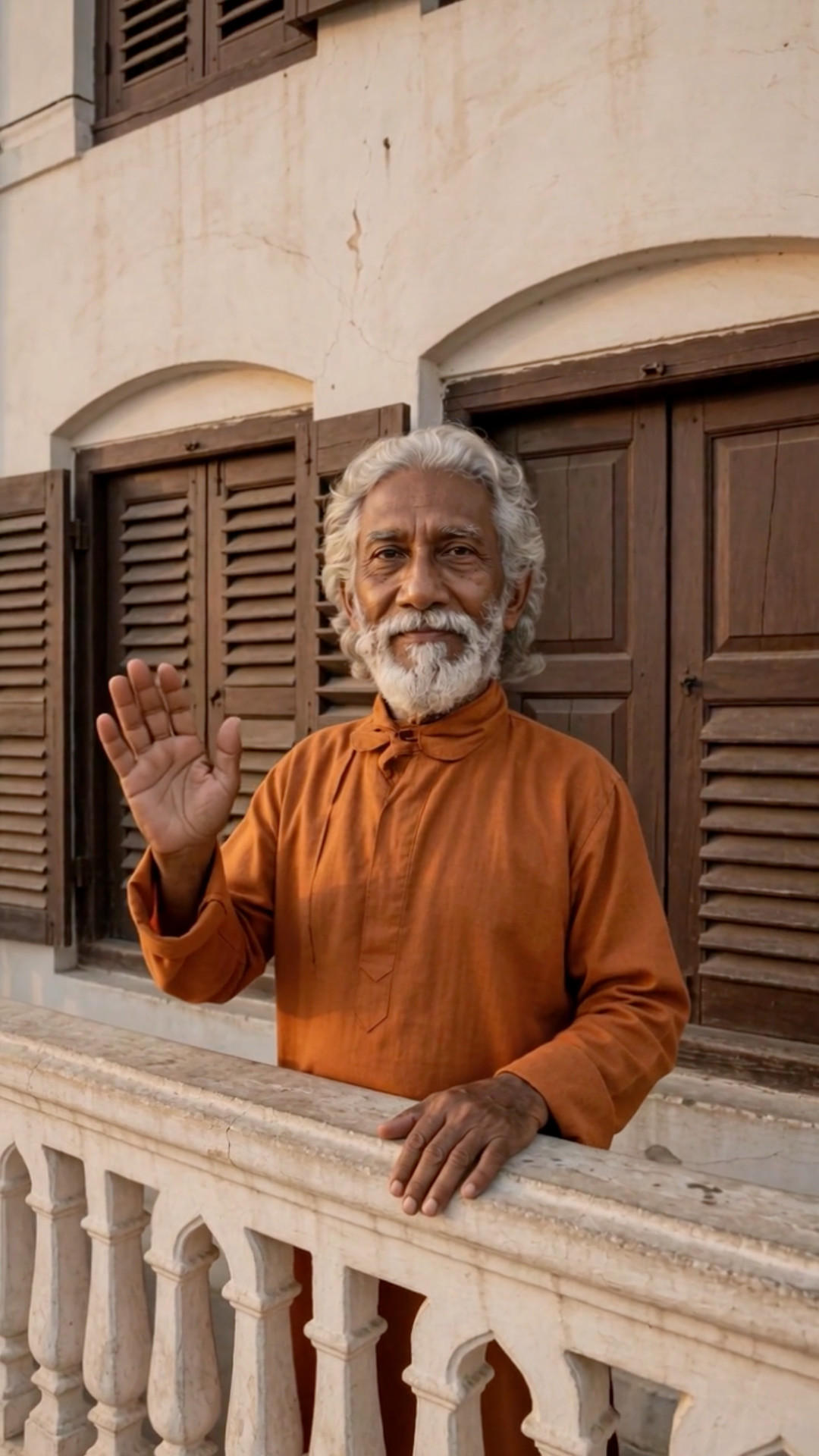
The Puri hermitage
At his seaside retreat, Sri Yukteswar receives all who come to the hermitage with the same courtesy: the powerful and the humble, the learned and the unlettered alike, as one who sees a single soul in every visitor.
The Puri hermitage
Chapter XII · "Years in my master's hermitage"
The Puri hermitage is the cheerful two-story house that Sri Yukteswar built with his disciples facing the Bay of Bengal, its balconies open to the murmur of the sea and the salt air. To this peaceful retreat a continuous stream of visitors comes from the world, and the Master welcomes them all with the same courtesy and refinement. He shows no special regard for the powerful or the learned, nor disdain for anyone's poverty or lack of letters: he listens respectfully to the truth on a child's lips and quietly overlooks the pedant's display, for to one who has realized himself as soul —and not as body or ego— the rest of humanity takes on a remarkable sameness. He is never dismayed by the arrival of unexpected guests; with few provisions he improvises a banquet under his inventive direction, and no one leaves the hermitage hungry or unsatisfied. And when a visitor finds him absorbed in the Infinite, he at once draws them into conversation, unable to make a show of his inner communion with God.
Walks along the beach
On his summer holidays by the sea, Sri Yukteswar and his young disciples go down to the Puri beach; the master leads the way and, laughing, has them march in file and in rhythm as he sings.
Walks along the beach
Chapter XV · "The Cauliflower Robbery"
During the summer holidays at the seaside hermitage, Mukunda wakes early, refreshed by the salt breeze and the beauty around him, when Sri Yukteswar's melodious voice calls: "Come, let us go to the beach." The master leads the way and a group of young disciples follows, at first scattered and out of step. With mute and gentle criticism he watches them: "When our Western brothers walk, they usually do so with a certain proud precision and symmetry; now, please, march two abreast, all keeping a rhythmic step." And he begins to sing, "Boys, come and go in a pretty row," matching without effort the brisk pace of his students. These morning walks along the shore are a living school of attentiveness and joy: in the smallest discipline —the way one walks— the master teaches how to wed the body's rhythm to the serenity of the soul.